Northern red-legged frogs are primarily diurnal. They are a medium-sized frog that can be found in a variety of aquatic habitat types and in terrestrial habitats. They have a prominent ridges (dorsolateral folds) from the eyes down either side of the back, and the under half of the hind legs are a bright red. They have long legs, smooth skin, and are a greenish-gray to reddish-brown color overall with dark flecks on the back, sides, and legs. Distinctive markings are a dark mask, a horizontal stripe from eye to shoulder, and cream and dark gray marble patterns on the throat and chest. Older frogs have red coloring on their sides, while juveniles have yellow under the legs and belly instead of red. The tadpoles are brown with small black flecks on the upper body and small light flecks on the lower body. Northern red-legged frogs are relatively large: males grow up to 2.7 inches, and adult females can grow up to 5 inches in length.
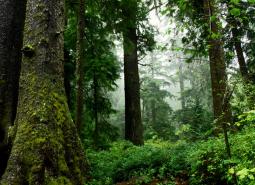
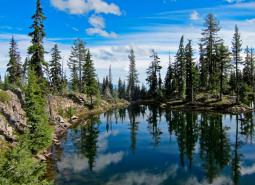
Northern red-legged frogs spend a greater portion of their life cycle in terrestrial habitats compared to other ranid species. Upland deciduous or coniferous forested areas with complex structure, a closed canopy, woody debris, small mammal burrows, and leaf litter provide important habitat year-round, and particularly during the non-breeding and overwintering periods. Northern red-legged frogs typically require ponds and wetlands with shallow areas and emergent plants. For breeding, they need access to forested wetland and upland habitats with sunny, exposed, still-water breeding sites with emergent vegetation. Breeding habitat can be seasonal or permanent, but water must be present for at least 5 months in duration. Thick submerged branches and stems are often used to deposit egg masses. Both adults and juveniles use moist riparian and upland forests.
Limiting factors
An important threat to Oregon populations of northern red-legged frog is the loss of wetlands, especially in the Willamette Valley. Loss of egg-laying habitat is a key limiting factor for this species. Hydrologic modifications to riparian and floodplain area, fragmentation and direct mortality associated with roads, suburban development, and other land use changes are likely to have direct effects on populations. Land management actions that affect canopy cover can reduce habitat quality for this species. Predation and competition by nonnative invasive fish and bullfrogs present further major threats. Warming and drying trends associated with climate change may exacerbate risks to populations from drought, wildfire, and altered hydrologic regimes.
Data gaps
• Increase knowledge of basic life history, including terrestrial habitat use, movement and dispersal, phenology, and relationships to hydrology.
• Estimate abundance and population size.
• Clarify impacts of climate change, pollutants, invasive plant and animal species, diseases (such as chytrid fungus) and parasites on this species.
• Identify seasonally important habitat components and overwintering areas.
• Conduct baseline monitoring to better understand threats, trends, and habitat associations.
• Assess how this species responds to forest management practices including timber harvest, fuels reduction, and restoration activities and how riparian buffer widths affect population parameters.
• Assess the effect that agricultural and urban toxins (including fertilizer run-off and sewerage) have on the species.
• Assess habitat carrying capacity for the species.
• Identify overwintering habitat associations.
• Assess vulnerability to climate change
Conservation actions
• Restore habitat.
• Revise wetland hydroperiod requirements for mitigation and other created wetlands in occupied areas to reduce ‘population sinks’.
• Create upland buffer and aquatic habitat retention requirements for housing developments to minimize local extirpations in the Willamette Valley.
• Identify regionally important sites to the species and work with partners to secure protections for these sites, and to improve or restore connectivity between them.
•Maintain wetland habitat with emergent plants and adjacent forest.
• Address barriers and/or culverts at key road crossings to reduce mortality of lowland (Willamette Valley and Coast Range) frogs, and monitor outcomes to improve mitigation effectiveness.
• Control bullfrogs and invasive fish at priority sites.
• Monitor priority populations.
• Maintain connectivity between wetland and upland sites to allow for life cycle movements.
• Establish priorities for disease monitoring and implement treatment or prevention programs as needed.
• Conduct outreach and education to support conservation.
• Identify and prioritize protection and management of habitats with high climate resiliency.
Key reference or plan
Environment and Climate Change Canada. 2017. Management Plan for the Northern Red-legged Frog (Rana aurora) in Canada. Species at Risk Act Management Plan Series. Environment and Climate Change Canada, Ottawa. 2 parts, 4 pp.+ 51 pp. Read here