Photo Credit: Teal Waterstrat, U.S. Fish and Wildlife Service
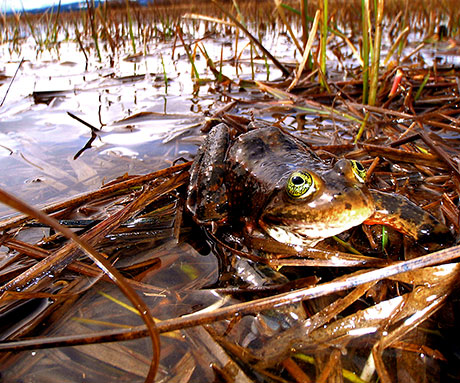
Oregon spotted frogs are the most aquatic frogs in the Pacific Northwest; often if you see one, you’ll only see its eyes peeking up out of the water. This medium-sized frog is named for the black spots that cover its head, back, sides, and legs. These spots have a light bump in the center, with blurred or scalloped edges. As individuals age, the spots become larger and darker, with less distinct edges. The juveniles are brown or olive green on the back, whereas adults are an overall reddish-brown, becoming redder with age. Their underparts are an opaque cream with red blotches, and the underside of their legs become a vivid orange-red with age. Adult females can grow to four inches in length from snout to vent, and males grow up to three inches. Tadpoles are dark in color above, with a lighter colored belly. Older tadpoles develop metallic flecks on their body. Spotted frogs can be distinguished from other similar species by their upward oriented eyes and large black spots with blurred or scalloped edges.
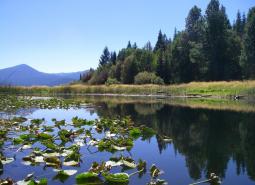
Oregon spotted frogs are a highly aquatic species that requires permanent water for its entire life cycle. Preferred habitats include permanent ponds, marshes and meandering streams through meadows for breeding and foraging. Oregon Spotted frogs breed and deposit eggs in shallow (<35 cm deep) standing water exposed to full sun with a bottom layer of dead and decaying vegetation. The species uses springs and other sites with low, continuous water flow for overwintering.
Limiting factors
Climate change is likely to have a profound impact on Oregon spotted frogs. Disturbances to the hydroperiod of Oregon spotted frog habitats or the connectivity between their seasonal habitats has significant impacts on habitat quality and extent. Adjustments to water levels at dams, reservoirs, irrigation ditches and other managed settings that decrease flow can reduce water levels needed for frog reproduction and overwintering. The primary cause identified for declines in Oregon spotted frog numbers across their range is the loss of the wetland habitat necessary to their life cycle. High fidelity to egg-laying sites limits the capacity of a population to recover after habitat loss by increasing vulnerability to inbreeding and extinction. Introduction of non-native species that prey on Oregon spotted frogs or their larvae, particularly brook trout (Salvelinus fontinalis) and American bullfrogs (Lithobates catesbeianus), also have been linked to the decline of the species. Loss of natural disturbances such as beavers contributes to vegetation encroachment in breeding areas.
Data gaps
• Document factors that impact population trends.
• Evaluate impacts of invasive fish and bullfrogs, grazing, and recreation on extant populations.
• Conduct feasibility studies on reintroduction at historic sites.
• Improve the limited information on recruitment rates of Oregon spotted frogs and obtain more data on population parameters to determine mortality rates and causes, and longevity to help with population modeling.
• Research impacts of climate change including effects of drought, altered spring runoff, and shortened hydroperiod.
• Continue inventory and monitoring efforts to document status and trends.
• Evaluate the effects of land management practices, fertilizers, pesticides, and herbicides on this species.
• Determine if species is present in the Willamette Valley Ecoregion.
Conservation actions
• Protect vegetation buffers around occupied sites.
• Improve hydrology to benefit overwintering and larval habitat.
• Control invasive species including reed canary grass, bullfrogs, and non-native fish at priority sites.
• Carefully manage livestock grazing at occupied montane wet meadows.
• Use results of feasibility studies to guide specific conservation actions and management decisions for reintroductions.
• Protect or restore habitat connectivity between populations.
• Retain and promote beaver habitats to restore wetland systems.
• Evaluate the potential for activities such as development, recreation, and/or water diversion to affect Oregon spotted frogs, and consider minimization or mitigation measures to limit impacts.
• Manage recreation to reduce siltation and disturbance at occupied sites.
• Establish priorities for disease monitoring and implement treatment or prevention programs as needed.
• Conduct outreach and education to support conservation.
• Seek opportunities to partner with ongoing efforts to verify species presence in historical range.
Key reference or plan
U.S. Fish and Wildlife Service. 2023. Draft Recovery Plan for the Oregon Spotted Frog (Rana pretiosa). Portland, Oregon. xi + 23 pages Read here
U.S. Fish and Wildlife Service. 2023. Draft Recovery Implementation Strategy for Oregon
spotted frog. Portland, Oregon Read here