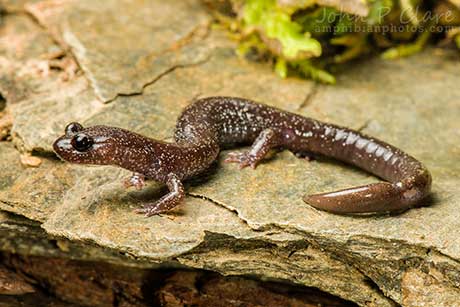
Siskiyou Mountains Salamanders are members of the lungless Plethodontid salamander family, and are found only in the Klamath-Siskiyou Mountains of southern Oregon and northern California. They have large eyes and glossy speckled skin. They are long and slender with short limbs, slightly webbed toes, and vertical grooves along the sides of the body. Adults are chocolate to purplish brown on their back with varying amounts of silvery-white speckling, and are grayish-purple underneath. Males are approximately 1.8 to 2.8 inches in length snout to vent, and females are slightly longer at 2.2 to 2.8 inches. Juveniles are dark brown to black on their upper surface, often with a light brown stripe on their back, and are gray underneath. Siskiyou Mountains Salamanders are closely related to Del Norte and Dunn’s salamanders, two other species that can be found in Oregon in the Klamath-Siskiyou ecoregion. These species can be hard to tell apart. The base color of these animals can help identify them in the field, though this characteristic is not reliable as there is a lot of variation and overlap in coloration in these species.
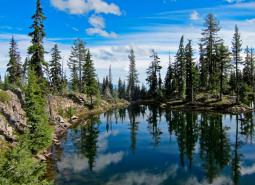
Siskiyou Mountains salamanders are strongly associated with talus, rocky outcrops, and cool, moist microhabitats in late-seral forests. North-facing slopes may provide more appropriate climatic conditions associated with salamander abundance. As a terrestrial lungless salamander, this species requires wet conditions for surface activity, preferring to remain underground when temperature and humidity are high.
Limiting factors
This species’ range is very restricted and limited to forests in the Applegate River drainage in Oregon. These lungless salamanders breathe directly through their skin, so they are particularly vulnerable to desiccation. They are also highly sensitive to forest management practices that result in disturbance to talus microhabitat or forest overstory.
Data gaps
• Assess distribution and trends.
• Increase knowledge of life history and population ecology, including phenology, dispersal, and habitat use.
• Evaluate the effects of forest management including harvest, prescribed fire, commercial thinning, and roads on the species and its habitat.
• Evaluate the effects of fertilizers, pesticides, and herbicides on this species.
• Determine whether disease, recreation, mining, climate change, and/or fires threaten or affect populations of Siskiyou Mountain Salamander.
• Assess climate vulnerability
Conservation actions
• Protect high priority conservation sites near existing reserve system lands, given the species’ dependence on mature forest cover.
• Manage for connectivity of suitable or occupied habitat patches to support dispersal and colonization.
• Ensure that land use practices retain essential characteristics of talus microhabitat.
• Consider seasonal activity patterns, and schedule surface activities when the species is not active (October 1-May 30).
Key reference or plan
Conservation Agreement for the Siskiyou Mountains Salamander (Plethodon stormi) in Jackson and Josephine Counties of Southwest Oregon. Read here