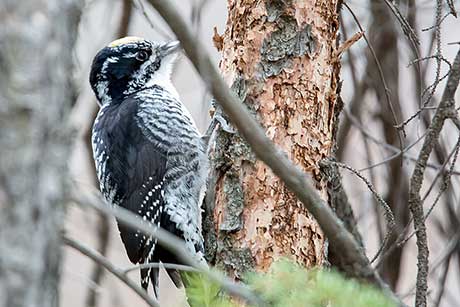
The American Three-toed Woodpecker (Picoides dorsalis) is a medium-sized woodpecker with black and white coloring. Unique features include a heavy, chisel-like bill and three toes (two pointing forward and one pointing backward). Adult birds have white underparts with heavy black barring on the sides and flanks. Upperparts are mostly black, with white barring on the center of the back. The head is mostly black with some white markings, including white forehead spots, white chin and throat, a white stripe extending from the base of the bill below the eye across the face, and a white stripe from behind the eye to the back of the neck.
Males have a large, yellow patch on the crown of the head typically bordered by white streaks. In females, the crown is entirely streaked with white. Juveniles are similar in appearance to adults, though duller overall.
Overview
Species Common Name American Three-toed Woodpecker
The American Three-toed Woodpecker is mostly sedentary and stays in one area year-round. It is considered a keystone species, especially in lodgepole pine forests. Its distribution closely follows the presence of spruce trees (Picea spp.) in North America, as well as lodgepole pine (Pinus contorta) and grand fir (Abies grandis) in Oregon.
These woodpeckers live in dense coniferous forests, usually at elevations above 5,000 feet. They require dead trees with heart rot and standing snags for nesting, and they depend on high numbers of wood-boring beetles for food. The species is often found in areas affected by large-scale forest disturbances, such as forest fires, disease outbreaks, and bark beetle infestations, which create many snags.
American Three-toed Woodpeckers are primary cavity nesters, meaning they excavate new nesting cavities each year. They typically feed by scaling the bark to search for bark beetles (family Scolytidae).
Limiting factors
American Three-toed Woodpeckers are rare and locally distributed in Oregon. Given their apparent dependence on older forests and diet specialization, reductions in snag availability due to fire suppression and forest health management may limit distribution. The species is susceptible to habitat loss from the removal of lodgepole pine forests related to pest management, including logging in stands considered susceptible to insect outbreaks and salvage logging in infested stands.
Data gaps
• Assess distribution, abundance, and trends. Population trend is currently undetermined, but the population is known to be irruptive.
• Improve understanding of habitat relationships and nesting ecology.
• More information is needed about winter behavior in Oregon.
• Population sizes can be difficult to estimate due to typically low densities, cryptic behavior and remote habitat.
• Survivorship, age of first breeding and most demographic parameters are lacking.
Conservation actions
•Conduct research to obtain information describing distribution, abundance, and trends
• Maintain areas of high snag density, especially above 5,000 feet where compatible with other forest management objectives. As an example, bark beetle-infested trees could be retained in areas where they present low risk of insect infestation to adjacent forests, thereby providing some habitat value for American Three-toed Woodpeckers.
Key reference or plan
American Three-toed Woodpecker (Picoides dorsalis): A Technical Conservation Assessment. Read here
PIF Focal and Imperiled Species. Rockwell et al. 2022. Read here
Conservation of Landbirds and Associated Habitats and Ecosystems in the East Cascade Mountains. Read here
Goggans, R., R. D. Dixon, and L. C. Seminara. 1989. Habitat Use by Three-Toed and Black-Backed Woodpeckers: Deschutes National Forest, Oregon. Oregon Department of Fish and Wildlife, Nongame Wildlife Program 87-3–02.