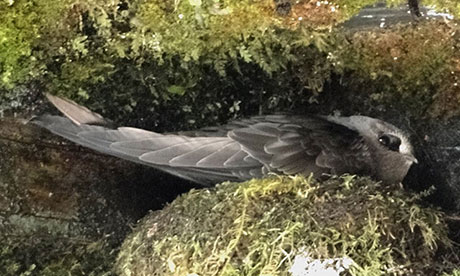
The Black Swift, Cypseloides niger, is a large Nearctic-neotropical migrant swift. Black Swifts are adept flyers and spend much of their time in flight at high altitudes foraging for insects, with flight altitudes documented up to at least 4300m. They are seldom observed in flight due to their typically high foraging altitude.
Adult Black Swifts are mostly dark, with sooty black feathers that look the same in both males and females. The top of the head and back of the neck are slightly lighter, with a brownish-gray color. Their undersides are black, but the chin and throat are a lighter gray-brown. If you look closely, you might notice that the feathers on the forehead and front of the head have light gray or white edges, giving their face a frosty, pale look.
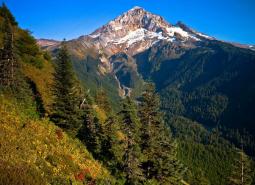
The subspecies that occurs in Oregon, Cypseloides niger borealis, or the Northern Black Swift, is a summer resident and presumed breeder from southeast Alaska and southern Alberta to southern California and Mexico. Wintering areas are not well known, and include the state of Amazonas, Brazil.
Black Swifts breed on small ledges in sea coast cliffs, behind waterfalls, and wet caves. In Oregon, their only known nesting site is at Salt Creek Falls. Nest sites appear to require the presence of water, high relief above the surrounding terrain, inaccessibility to terrestrial predators, darkness or shading of nest niches, and unobstructed flyways for approaching the nest.
Limiting factors
The Black Swift is among one of the least understood North American neotropic migrant species. The species has small and disjunct populations, discrete and unique nesting habitat, and data at nesting sites is very limited. Potential impacts from land use changes include impacts to the hydrological cycle and availability of aerial insect prey. Due to their dependence on aerial insects, they are susceptible to starvation during prolonged events of cold and wet weather.
Data gaps
• Reproductive and nesting biology have not been investigated in Oregon.
• Little detailed information is available on breeding and population biology of the species in Oregon.
• Survey potential nesting sites to determine occupancy; verify key ecoregions
• Limited information on wintering locations, behavior, and threats impacting Black Swifts on wintering grounds
Conservation actions
• Limit human disturbance and habitat alteration around waterfall nesting locations and minimize disturbance to forested habitat around sites.
• Maintain water flow (waterfalls) at occupied sites.
• Improve detection methods.
• Develop partnerships with biologists and communities in migratory pathways and wintering habitats to facilitate full life-cycle conservation
Key reference or plan
Altman, B. (2003). Inventorying Black Swift Populations at Waterfalls in the Northern Pacific Rainforest Bird Conservation Region. Read here
American Bird Conservancy; Black Swift (Cypseloides niger): A Technical Conservation Assessment. Read here