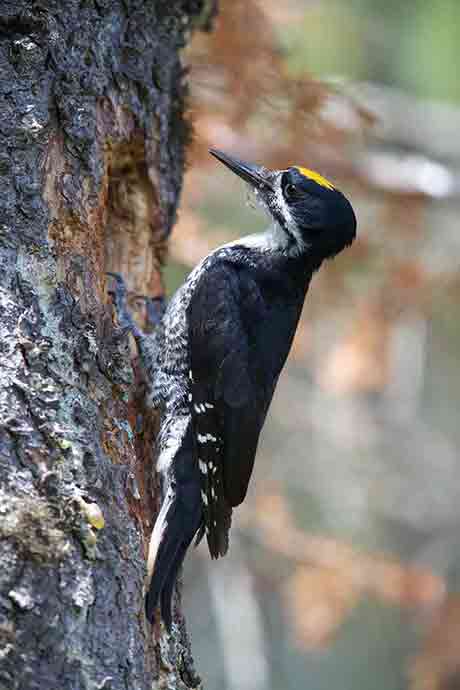
Black-backed Woodpeckers (Picoides arcticus) are medium-sized woodpeckers, measuring about 9 to 9.5 inches in length and weighing between 2 and 3 ounces. They are easy to recognize by their striking black-and-white coloring: their backs and heads are solid black, while their undersides are white with black bars along the sides. They have a single white stripe, or “mustache,” running from the base of the bill across the face. Males and juveniles have a prominent, bright yellow patch on the crown of the head.
Black-backed Woodpeckers are closely associated with forests that have recently experienced fire or other major disturbances, like bark beetle outbreaks. They are highly adapted to post-fire environments and are often among the first species to move into burned areas.
Black-backed Woodpeckers are habitat specialists, most often associated with insect outbreaks and high intensity fires resulting in large stands of standing dead wood, though they also occur in unburned forests. They require forested habitats, usually above 5,000 feet, and can be found across dense, closed canopy montane coniferous forests. Suitable habitat includes dead trees with heart rot for nesting and high densities of wood-boring beetles for foraging. Large-scale forest disturbances (e.g., forest fires, disease pockets, and bark beetle outbreaks) often produce a high density of snags suitable for Black-backed Woodpeckers. In northeast Oregon, nest site selection is consistent despite changes in available habitat due to beetle infestation and fire; they preferentially select living or dead ponderosa pines or western larch with minimal decay and intact tops.
Limiting factors
The Black-backed Woodpecker has small, often disjunct populations and specific habitat requirements, which make the species especially susceptible to local and regional extirpations. The bird relies on mature forests with abundant snags and standing dead trees that provide nesting and foraging sites, but fire suppression and forest health management have reduced snag availability. The use of insecticides to control beetle outbreaks also impacts the woodpecker’s food supply, as it primarily feeds on wood-boring beetles. Its highly specialized diet and preference for early post-fire habitats further limit its ability to adapt to habitat changes. In Oregon, Black-backed Woodpecker nesting success and abundance are negatively affected by post-fire salvage logging practices that remove standing burned trees, which can significantly reduce the availability of suitable nesting and feeding habitat in burn sites.
Data gaps
• Assess population size and trends
• Collect information on habitat relationships and habitat use in Oregon
• Assess nesting ecology
Conservation actions
• Maintain areas of high snag density in wildfire and other disturbance areas, especially above 5,000 feet, where compatible with other forest objectives (e.g., maintain bark beetle infested trees in areas of low risk of insect infestation into adjacent forests).
• Use forest pest management practices compatible with Black-backed Woodpeckers
•Consider Black-backed Woodpecker habitat needs in salvage logging plans following fire
Key reference or plan
PIF Focal and Imperiled Species. Rockwell et al. 2022. Read here
Conservation of Landbirds and Associated Habitats and Ecosystems in the East Cascade Mountains. Read here