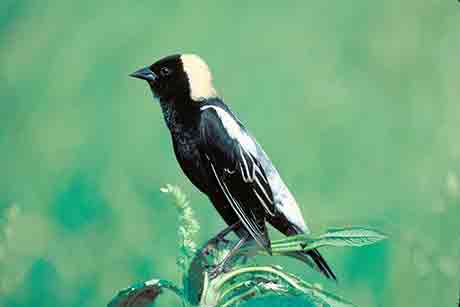
The Bobolink is a medium-sized songbird that lives in grasslands. It measures between 15.2 and 20.5 cm in length. In all plumages, Bobolinks have rigid, pointed tail feathers, large flat heads, short necks, and long hind toenails that are easy to see.
Bobolinks are sexually dimorphic: adults look different depending on their sex. During the breeding season, males have a yellow nape and are black on the front of the head, wings, and tail, with white or pale gray back, scapulars, lower back, rump, and upper tail coverts. Bill on the male is glossy and black during the breeding season. In non-breeding plumage, males are similar in appearance to females.
Females are yellow-brown underneath and olive above with brown and white streaking on the flanks, sides, and under-tail coverts. They have a dark eyeline and broad buffy crown stripe bordered by dark brown stripes.
Adult males are slightly larger than females: males weigh between 34 and 56 grams, while females weigh between 29 and 49 grams.
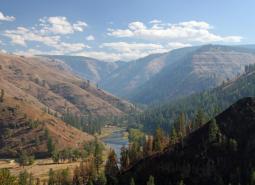
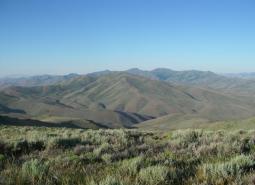
Grassland obligates, Bobolinks traditionally nest in native tall-grass and mixed-grass prairies, but due to the conversion of prairie lands to agricultural landscapes they have adapted to nesting in agricultural habitats, especially hay fields. Bobolinks are migrant grassland birds that use broad leaf forbs (e.g., clover, alfalfa, false lupine, potentilla) for nesting cover and food resources. They feed primarily on insects and other invertebrates, seeds, and grains. The Bobolink population at Malheur NWR (Blitzen Valley and DoubleO) represents the largest population west of the Great Plains, and was once the only population in Oregon. They show preference for mesic meadows over wet meadow habitat and persist on Malheur NWR on irrigated areas which are mowed in late summer and grazed the rest of the year.
Limiting factors
This species has experienced steep declines due to changes in land use. It persists in small, scattered colonies, many of which are found on private land. Bobolinks are sensitive to flooding and some agricultural practices. Wind energy facilities may pose a barrier to Bobolinks, though incidences of Bobolink mortality are low. Causes of Bobolink population declines range-wide include large scale habitat fragmentation and loss due to urban development or agricultural activity. Pesticide use and declining insect populations may also threaten Bobolink populations. The timing and disturbances of haying can destroy nests and young Bobolinks. The change from hay crops to more intensive agriculture have had a negative impact on Bobolink populations.
Data gaps
• Assess abundance and trends.
• Assess connectivity and impacts to Oregon’s population of Bobolinks during migration and overwintering
• Evaluate the effects of cowbird parasitism and corvid predation on breeding success.
Conservation actions
• Expand partnerships with private landowners to manage Bobolink habitat.
• Remove residual vegetation and stimulate new growth prior to the breeding season.
• Delay field maintenance (e.g., mowing, haying) until after the breeding season.
• Develop partnerships with biologists and communities in migratory pathways and wintering habitats to facilitate full life-cycle conservation
Key reference or plan
Conservation Strategy for Landbirds in Sagebrush-Steppe and Riparian Habitats of Eastern Oregon and Washington. Read here