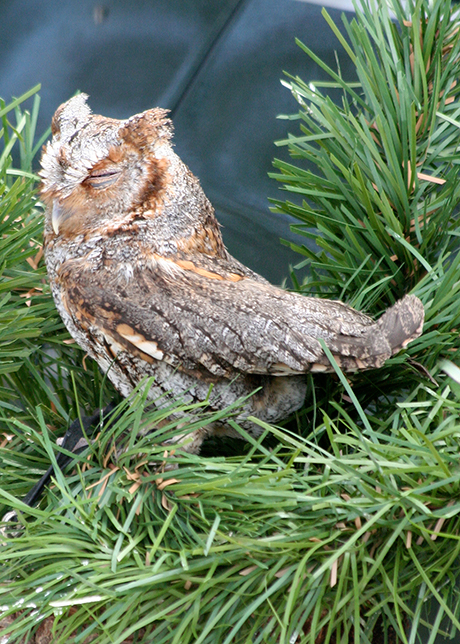
The Flammulated Owl (Psiloscops flammeolus) is one of the smallest owl species in North America. It measures about 15 to 17cm in length and weighs between 45 and 60g. Among the small owls found in its range in North America, it is the only owl with dark eyes. Male Flammulated Owls have slightly longer wings than females, while females tend to be a bit heavier (averaging 54g for males and 57g for females). Adult plumage is similar between the sexes. Body plumage is gray with black streaks and crossbars, often showing a rufous tinge. Their flight feathers and wing coverts are gray to brown with lighter bands. They also have short ear tufts, which may be hard to distinguish.
Flammulated Owls inhabit mid-elevation forests (3,880–4,600 feet) that typically lack a developed understory. They use small, dense thickets for roosting and forage for insect prey in nearby open patches of grassland or meadow. They are secondary cavity nesters, and rely on existing woodpecker holes or natural cavities in medium to large snags or deformed trees for nesting. Flammulated Owls are insectivorous Neotropical migrants, traveling to central Mexico during the winter, which is one of the longest migrations of any owl species. Little is known about their specific wintering habitat.
Limiting factors
The primary threat to the Flammulated Owl in Oregon is habitat loss and degradation. Habitat degradation by encroaching trees and shrubs (often as a result of fire suppression), loss of ponderosa pine trees and snags, and limited snag and cavity availability can adversely affect this species. Flammulated Owls are reliant on availability of nesting cavities, and declines in cavity-forming species (e.g. Pileated Woodpecker) may result in decreased cavity availability for Flammulated Owls. They have low reproductive rates, making them vulnerable to incremental decreases in fecundity caused by pollution, habitat alteration, or climate change. Insect control may also reduce prey availability. As a migratory species, threats on wintering grounds including habitat loss and degradation may have profound impacts to the stability of Flammulated Owl populations, though limited information is available on wintering bird behavior or migratory stopover habitats.
Data gaps
• Complete inventory for occurrence and distribution.
• Impact of forest management practices on habitat suitability for the species.
• Describe basic nesting ecology.
• Obtain better data on statewide population estimates, trends and other demographic data: BBS does not effectively capture trend data.
• Identify concerns and consequences of fire suppression in breeding area forests.
• Determine any concerns or threats to the species in their winter areas.
• Study impacts of deforestation in the winter range in Central Mexico.
Conservation actions
• Retain or enhance management practices to enhance mature forest conditions.
• Promote snag retention.
• Minimize insect control around forest openings near nesting areas.
• Use and monitor nest-boxes in areas of deficient snags.
• Work with Mexican authorities to protect key pine-oak habitat on the species’ wintering area.
Key reference or plan
Conservation of Landbirds and Associated Habitats and Ecosystems in the East Cascade Mountains. Read here