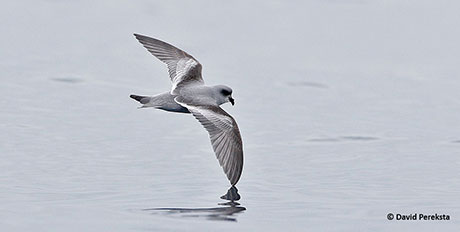
The Fork-tailed Storm-Petrel (Hydrobates furcatus) is a seabird that is found only in the North Pacific Ocean. They can spend up to 8 months of the year at sea. In North America, they nest along the Pacific coast from Alaska to northern California.
The Fork-tailed Storm-Petrel has pale bluish-gray upperparts and pale, pearly gray underparts, with dark underwing coverts. They are medium-sized and have a small bill, dark gray forehead, and dark ear patch. Fork-tailed Storm-Petrels have a long, forked tail although it may not always be visible. Sexes are similar in plumage and body size.
The species’ northern wintering range limit is set by the edge of the Bering Sea ice pack, usually below 56° N. High densities of wintering individuals are seen between 31° and 36° N and likely consist of birds from breeding colonies in northern California and Oregon.
Fork-tailed Storm-Petrels nest on coastal islands. They use crevices or sites with deep, sandy soil for burrowing amid ground cover vegetation. During the day, when they are away from their nesting colonies, these birds search for food like small swimming crustaceans, fish, and dead marine mammals that float on the ocean’s surface. They may forage nearshore and in colder waters off the continental shelf, but usually within 75 km of known colonies.
Limiting factors
Fork-tailed Storm Petrels breed in small numbers in Oregon. Their nest sites are vulnerable to predation by non-native and native mammalian predators, including river otters, foxes, martens, and racoons. River otters in particular feed on large numbers of adult and nestling Fork-tailed Storm Petrels. Threats to their coastal and marine habitats include climate change, pollution (such as oil spills and other contaminants), habitat loss, and overfishing. Changes in ocean conditions driven by climate change also pose significant risks. Additionally, adults are vulnerable to ingesting plastics and oil due to their surface-foraging behavior at sea.
Data gaps
• Assess population dynamics. Population dynamics are not well documented, due in part to the species’ nocturnal attendance at colonies, well-hidden burrow nests, and unknown migratory extent.
• Increase knowledge of breeding biology and foraging areas.
• Assess the impacts of light attraction at onshore and offshore energy facilities, potential impacts of wave and wind energy or other developments.
Conservation actions
• Maintain existing closure of nesting areas to human visitation.
• Continue implementing mammalian predator control at Oregon seabird colonies.
• Improve census/survey methods.
• Monitor and minimize impacts from ocean and coastal energy development projects.
Key reference or plan
Regional Seabird Conservation Plan, Pacific Region. Read here