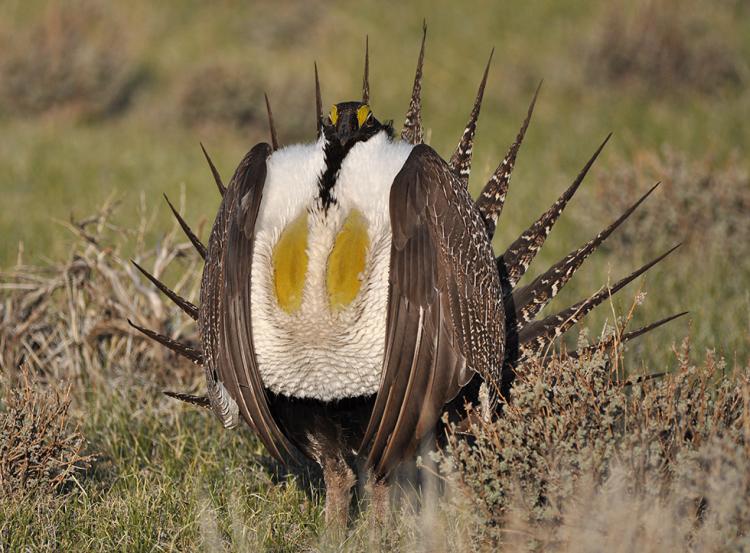
Photo Credit: Jeannie Stafford, U.S. Fish and Wildlife Service
Greater sage-grouse are birds that occupy sagebrush habitats within the semi-arid deserts of Eastern Oregon. Sage-grouse feathers are colored to hide the birds among the volcanic scab rock and sagebrush areas they occupy. Males have white showy breast feathers during the breeding season and are larger than females – six and a half pounds and three pounds respectively. Females retain camouflage feathers throughout the year.
Greater Sage-Grouse require large, contiguous expanses of high-quality (State A) intact sagebrush habitat for year-round survival, including suitable nesting and brood-rearing habitat for successful breeding and chick production. They use wet meadows and playas during brood-rearing, especially areas with native forbs. They also require suitable wintering habitat with high quality forage for overwinter survival. For a description of ecological states of sagebrush habitats, see: Threat-Based Land Management in the Northern Great Basin: https://catalog.extension.oregonstate.edu/pnw722/html
Limiting factors
Greater Sage-Grouse have experienced population declines and local extirpations in Oregon. Habitat loss and fragmentation, juniper expansion into sagebrush habitats, increased propensity of invasive annual grasses and plants, and impacts of increased fire frequency and intensity within sagebrush habitats, largely due to invasive annual grasses, have all contributed to sage-grouse population declines. This species is dependent upon large expanses of high-quality intact sagebrush habitat for year-round survival, including suitable nesting and brood rearing habitat for successful breeding and chick production, and suitable wintering habitat with high quality forage for overwinter survival. Greater Sage-Grouse are especially sensitive to human disturbance during the breeding season.
Data gaps
Monitoring data is needed to inform adaptive management, including:
1. Sage-Grouse biological data;
2. human development within Sage-Grouse habitat;
3. conservation and mitigation actions;
4. landscape-level habitat quantity and quality; and
5. site-specific habitat condition.
Conservation actions
• Implement conservation actions identified in Greater Sage-Grouse Conservation Assessment and Conservation Strategy for Oregon (Cline et al 2025), Sage-grouse Action Plan (Sage-Grouse Conservation Partnership 2015), and updated planning documents.
• Prevent further sagebrush habitat loss and promote sagebrush recolonization of former habitats following site specific guidelines. Prioritize restoration in occupied areas and areas adjacent to known leks.
• Control or stop the spread of invasive annual grasses, and reduce or eliminate the establishment of invasive annual grasses.
• Implement best practice, proactive fire risk reduction strategies to reduce the threat wildfire poses to Sage-Grouse habitat and important areas of connectivity.
• Conduct fuel management treatments designed to protect existing high-quality sagebrush habitat, modify fire behavior, restore native plants, and create habitat resilience and landscape patterns that benefit Sage-Grouse
Key reference or plan
Cline, M. L., S. K. Vold, and G. S. Jackle. 2025. Greater Sage-Grouse Conservation Assessment and Strategy for Oregon, 3rd edition. Oregon Department of Fish and Wildlife, Salem, OR.
Hagen. 2011. Greater Sage-Grouse Conservation Assessment and Conservation Strategy for Oregon Read here