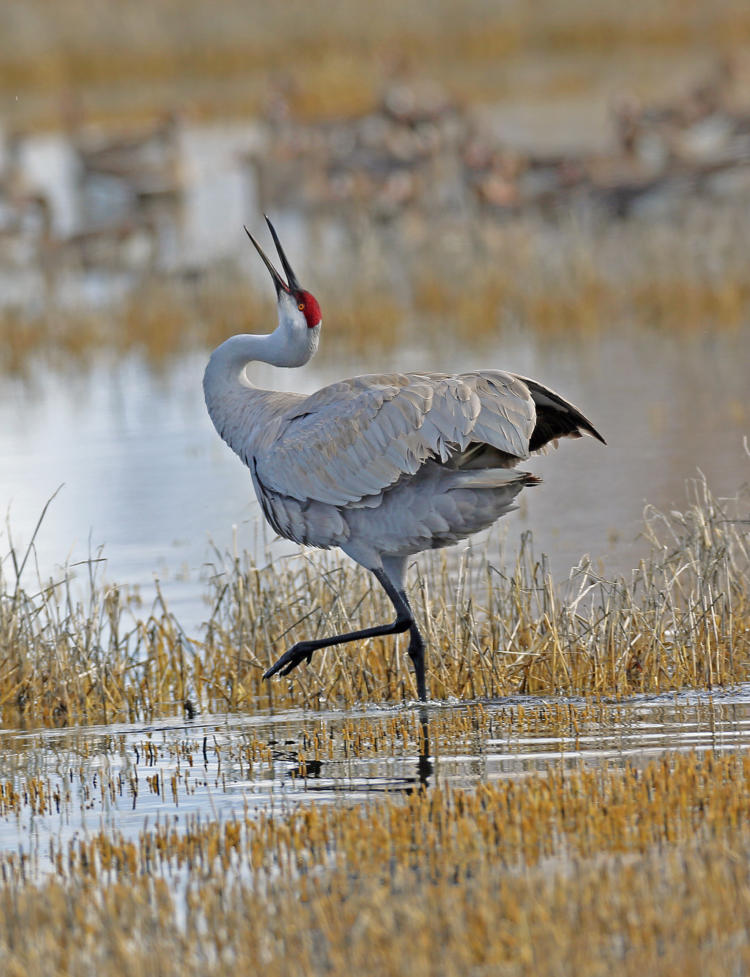
Greater Sandhill Crane dancing. Photo Credit: Keith Kohl
The Greater Sandhill Crane (Antigone canadensis tabida) is one of two subspecies of Sandhill Crane found in Oregon. It is distinguished by its red crown and white cheek patches contrasting with a light grey body. This large bird flies characteristically with its long neck extended straight ahead and long legs extended behind. Adults look alike although males are slightly larger than females. The Greater Sandhill Crane has a very distinct guttural bugling call. The other subspecies of Sandhill Crane in Oregon is the Lesser Sandhill Crane.
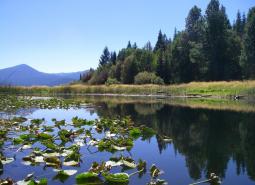
Greater Sandhill Cranes breeding in Oregon are generally associated with isolated, remote wet meadows and emergent marsh wetlands in southeast and south central Oregon. They need relatively large wetland-wet/dry meadow complexes with a mosaic of aquatic and herbaceous conditions for nesting and foraging. Malheur NWR, Sycan Marsh, and Klamath Marsh NWR, with their expansive suitable habitat and long history of use, support larger breeding concentrations of this species in Oregon. Greater Sandhill Cranes breeding in Oregon mostly winter in the Central Valley of California.
Limiting factors
Greater Sandhill Cranes have large area requirements. They are sensitive to disturbance and reductions in wetland/wet meadow quality, quantity, and size due to hydrological changes, succession (shrub and conifer encroachment), and/or livestock grazing. Impacts of agricultural practices (e.g., mowing, unmanaged grazing) limit nesting. Coyotes predate young. Common Ravens (Corvus corax) predate eggs. Sandhill Cranes are known to collide with power transmission lines, but few documented instances in Oregon.
Data gaps
• Estimate habitat area requirements relative to the quality of the habitat.
• Study differences in food resource utilization in wet and dry meadows and across breeding sites.
• Assess the impacts of livestock grazing on habitat suitability.
• Quantify the effects of nest predation under different habitat conditions.
• Evaluate the effects of recreational disturbance on this species.
Conservation actions
•Maintain and/or enhance hydrological conditions to support suitable habitat conditions for nesting and foraging in tracts >20 acres.
•Where hydrology can be managed, include both wet and dry meadow habitat through the nesting season in planning.
• Minimize disturbance during the breeding season (April 15-July 31) at known nesting areas.
•Use prescribed burning or hand-felling of trees periodically to set back plant succession.
Key reference or plan
Priority Information Needs for Sandhill Cranes. Read here
Greater Sandhill Crane Habitat Initiative. Read here