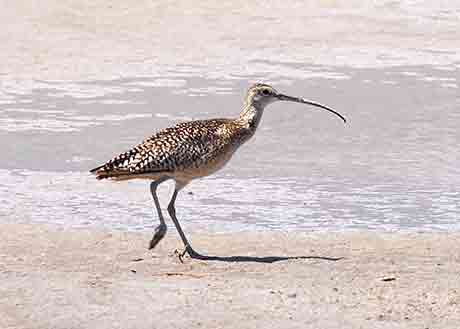
The Long-billed Curlew (Numenius americanus) is North America’s largest shorebird and the world’s largest sandpiper. They have an extremely long bill and have a loud, ringing call. They have a buff-colored body with cinnamon or pink highlights, upperparts barred with dark brown, a plain crown, ashy gray feet and legs, and a pink base on the lower bill. In flight, the underwings are noticeably cinnamon-colored. The Long-billed Curlew’s body length is approximately 500-650 mm, with a wingspan of 257-308 mm. This species exhibits sexual dimorphism. Females bills can be three times the length of their heads and are flatter with a distinct curve at the tip. They also have larger bodies, up to one-third larger than males.
Overview
- Species Common Name Long-billed Curlew
- Species Scientific Name Numenius americanus
- State Listing Status Sensitive
Ecoregions
Blue Mountains
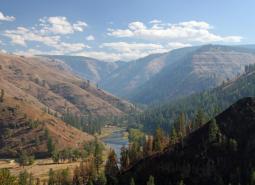
Located in NE Oregon, the Blue Mountains ecoregion is the largest ecoregion in the state. It provides a diverse complex of mountain ranges, valleys, and plateaus that extend beyond Oregon into the states of Idaho and Washington.
Columbia Plateau
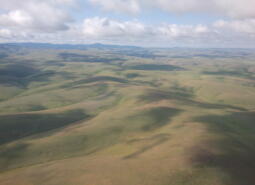
The Columbia Plateau ecoregion was shaped by cataclysmic floods and large deposits of wind-borne silt and sand earlier in its geological history. It is dominated by a rolling landscape of arid lowlands dissected by several important rivers, and extends from the eastern slopes of the Cascades Mountains, south and east from the Columbia River to the Blue Mountains.
East Cascades
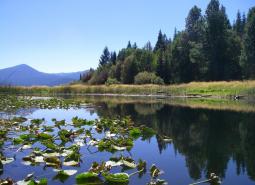
The East Cascade ecoregion extends from the Cascade Mountains' summit east to the warmer, drier high desert and down the length of the state. This ecoregion varies dramatically from its cool, moist border with the West Cascades ecoregion to its dry eastern border, where it meets sagebrush desert landscapes.
Northern Basin and Range
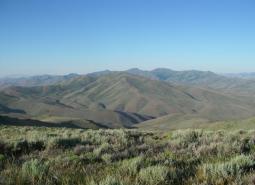
The Northern Basin and Range ecoregion covers the very large southeastern portion of the state, from Burns south to the Nevada border and from the Christmas Valley east to Idaho. It is largely a high elevation desert-like area dominated by sagebrush communities and habitats.