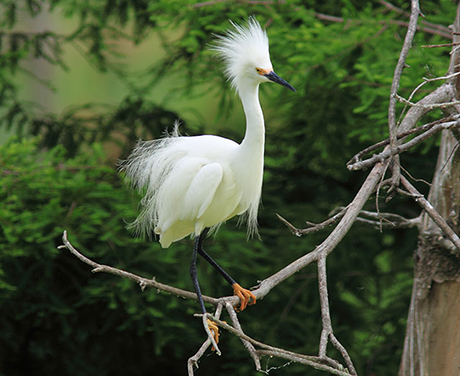
Photo Credit: Mary Ellen Urbanski, U.S. Fish and Wildlife Service
The Snowy Egret (Egretta thula) is a medium-sized heron that lives in wetland habitats. Males and females look alike, with pure white plumage throughout the year. During the breeding season, adults of both sexes develop long, delicate plumes along the back of the neck, lower scapulars, and breast. The bill is long, narrow, and mostly black, but the base of both upper and lower mandibles is yellow. Their legs are long and slender, usually black, though sometimes they show lighter yellow or red coloring along the back of the lower leg (tarsus). The feet of breeding adults are bright yellow, orange, or red, while juveniles and non-breeding adults have dull yellow-green feet. The bare skin between the eyes and bill (lores) is yellow year-round but becomes brighter yellow to red during the breeding season. Snowy Egrets also have a narrow yellow eye-ring that remains throughout the year.
In Oregon, Snowy Egrets persist in small, isolated breeding colonies. The largest known breeding site is Malheur Lake, where 227 breeding pairs were recorded at its peak in 1985, but numbers have since declined. Evidence suggests that Snowy Egret populations are decreasing both in Oregon and across the Great Basin region.
The Snowy Egret is a wetland generalist and nests in woody or herbaceous vegetation including trees, shrubs, and stout herbaceous vegetation, such as hardstem bulrush, for nest sites. Preferred nesting habitat locations are located over deeper water.
Limiting factors
Habitat degradation and loss remain among the most significant threats to the species. Wetlands in the Great Basin are naturally limited, and additional losses due to land use, water diversion, and development further reduce available breeding and foraging habitat. Climate change adds another layer of vulnerability, potentially altering wetland hydrology and increasing the frequency and severity of drought. Snowy Egrets are also susceptible to contaminants that can accumulate in wetland ecosystems. Toxins, including heavy metals and organochlorines, can lead to eggshell thinning and other reproductive problems. Snowy Egrets are colonial nesters and generally considered sensitive to human disturbance. Historically, the species was heavily impacted by the millinery trade in the late 19th and early 20th centuries, when large numbers were killed for their breeding plumes. While that threat has been addressed, ongoing habitat loss, contamination, and climate change continue to pose risks to their long-term survival in the region.
Data gaps
• Demographic data for Snowy Egret in Oregon are lacking.
• Determine population size and trends in Oregon, as BBS data is limited.
• Genetics data for Snowy Egret is lacking.
• Investigate competition with other herons and egrets, especially non-native Cattle Egrets (Bubulcus ibis).
Conservation actions
• Minimize human disturbance in nesting areas during the breeding season.
• Protect and restore suitable habitat near occupied sites
Key reference or plan
Waterbird Conservation for the Americas. Read here