
The Swainson’s Hawk (Buteo swainsoni) is a medium-sized broad-winged hawk of open habitats. They are long distance migrants, and individuals may migrate up to 10,000km to wintering habitat in Brazil, Paraguay, and Argentina. They exhibit polymorphism with distinctive dark and light color morphs also showing intermediate characteristics in between. Dark morph individuals are relatively uncommon, comprising an estimated 10 percent of the population. Dark morph plumage ranges in color from reddish-brown to a dark brown overall, with dark brown head, back, and upper wing. Light morph individuals have brown to grey upperparts, with a light belly and reddish-brown chest. In comparison to other species in the Buteo genus, Swainson’s Hawks have relatively long, narrow wings with noticeable tapering at the tips.
Overview
- Species Common Name Swainson's Hawk
- Species Scientific Name Buteo swainsoni
- State Listing Status Sensitive
Ecoregions
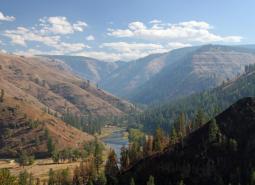
Blue Mountains
Located in NE Oregon, the Blue Mountains ecoregion is the largest ecoregion in the state. It provides a diverse complex of mountain ranges, valleys, and plateaus that extend beyond Oregon into the states of Idaho and Washington.
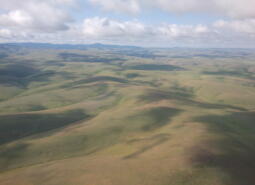
Columbia Plateau
The Columbia Plateau ecoregion was shaped by cataclysmic floods and large deposits of wind-borne silt and sand earlier in its geological history. It is dominated by a rolling landscape of arid lowlands dissected by several important rivers, and extends from the eastern slopes of the Cascades Mountains, south and east from the Columbia River to the Blue Mountains.
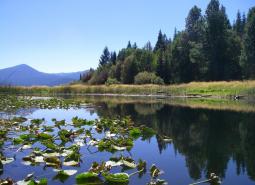
East Cascades
The East Cascade ecoregion extends from the Cascade Mountains' summit east to the warmer, drier high desert and down the length of the state. This ecoregion varies dramatically from its cool, moist border with the West Cascades ecoregion to its dry eastern border, where it meets sagebrush desert landscapes.
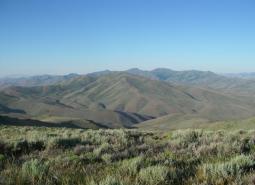
Northern Basin and Range
The Northern Basin and Range ecoregion covers the very large southeastern portion of the state, from Burns south to the Nevada border and from the Christmas Valley east to Idaho. It is largely a high elevation desert-like area dominated by sagebrush communities and habitats.