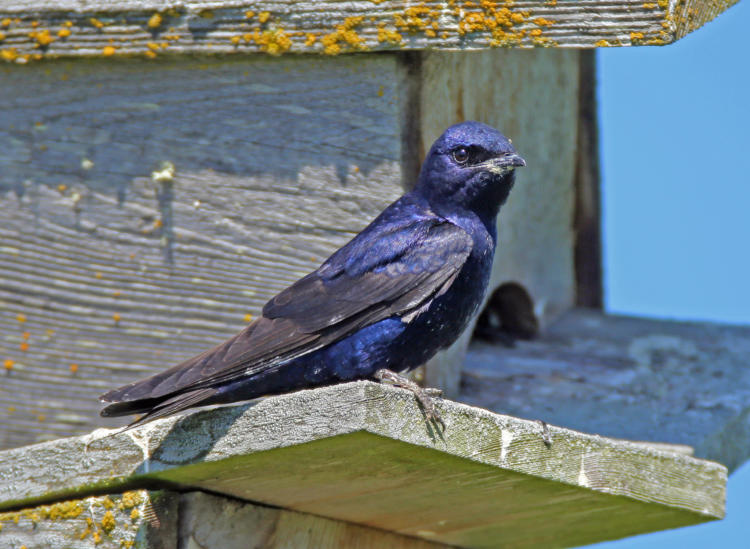
Purple Martin perched on a nest box. Photo Credit: Keith Kohl
Purple Martins are the largest swallows of the Americas. They weigh about 56 grams on average, which is twice as much as the second-largest swallow in North America. They are about 20 centimeters long from head to tail.
Purple Martins have dark, shiny (iridescent) feathers on their backs, heads, and chests, along with dark feathers under their wings. Their beaks are black or dark brown with a yellow gape that turns lighter, or horn-colored, as they get older. Their eyes are dark brown, and their feet are black or dark brown.
Sexual dimorphism is strong and adult male and female plumage are strikingly different. Males have a dark blue to purplish sheen, sometimes appearing black, throughout their body plumage. Adult females and younger birds have dark blue or purple feathers on their backs, with a lighter gray or white patch on their neck and forehead. Their undersides, including the throat, are pale and have light streaks.
Purple Martins require abundant cavities for colonial nesting. They prefer sites with close proximity to water and large, open areas with sufficient perching structures for foraging. Purple Martins readily use nest boxes and are most common at sites where nest boxes have been provided and establishing colonies, such as in the Willamette Valley, at some Nearshore coastal estuaries, and at sites along the Columbia River. Purple Martin require large open spaces (>15 ha) where they can forage for aerial insects, along with perching structures and cavities in these open spaces for nesting and roosting.
Limiting factors
The decline of Purple Martins early in the last century has been largely attributed to forest management practices reducing nesting structures and early seral habitat. Suitable breeding habitat is recognized as a limiting factor for Western Purple Martin populations. Decline in available early seral forest is a concern.
Additional limiting factors include threats on wintering grounds in South America, availability and competition for suitable nesting sites, reduction of natural cavities from human activities and competition from non-native European Starlings, and environmental impacts on insect food availability.
Data gaps
• Evaluate the effects of pesticides on this species.
• Evaluate the causes of declines and seasonal availability of insect prey (land-use changes, pesticide use, impacts of climate change).
• Determine and document the locations of wintering areas for the subspecies in in southeastern Brazil.
• Work with partners to safeguard wintering areas.
• Assess impacts to Oregon breeding birds at wintering areas and migratory stopover sites.
• Develop partnerships with biologists and communities in migratory pathways and wintering habitats to facilitate full life-cycle conservation
Conservation actions
• Restore suitable breeding habitat, as it is a limiting factor for Western Purple Martin populations.
• Retain and promote natural cavities/snags.
• Purple Martin populations and other insectivore species are threatened by declining insect prey populations in both their breeding and wintering ranges.
• Implement restoration and conservation measures needed to address insect population declines for overall ecological and integrity (e.g. landscape management, pesticide uses and climate change resilience measures).
Key reference or plan
Vesley, D. Conserving Purple Martins in OSU’s McDonald-Dunn Research Forest: Final Project Report. 2014. Read here
Conservation Assessment for the Purple Martin on the Interagency Special Status/Sensitive Species Program. Read here
Hagar, J., and L. Sherman (2018). Distribution and Habitat Use of Snag-nesting Purple Martins in Western Oregon. Interagency Special Status/Sensitive Species Program/ISDU Bureau of Land Management/USDA Forest Service. Read here