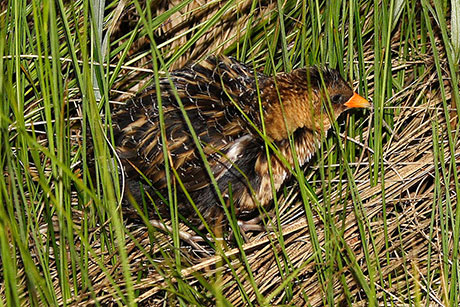
Once thought to be extirpated from Oregon in the 1940s, Yellow Rails were rediscovered in the state during the 1980s and 1990s. Yellow Rails are small birds, measuring only 5 to 7.5 inches long and weighing just 1.5 to 2 ounces. They are the second smallest rail species native to North America.
These birds are very well camouflaged in their wetland habitats, with colors that help them blend into the grass and reeds. They are also fast runners and can move quickly through thick, marshy vegetation on their long legs and large feet, which makes them very hard to spot.
During the breeding season, males have a bright yellow bill and are slightly larger than females, but otherwise sexes are alike in coloration. Their undersides are a buffy yellow with a white lower belly, while their backs are deep brown and black with buff-colored stripes. The top of the head (crown) is dark brown, and they have a dark stripe through the eye. Chicks are covered in soft black down and have pink bills.
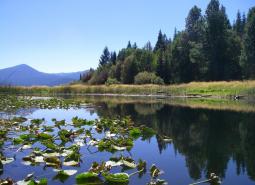
Yellow Rails mostly breed in wetlands east of the Rocky Mountains, across Canada and the Upper Midwest of the U.S., and they migrate to winter along the southeastern coast from Texas to North Carolina. There is a disjunct population in Oregon and California. In Oregon they are found only in a few scattered marshes in southcentral Oregon during the breeding season, including around Summer Lake, Klamath Marsh National Wildlife Refuge, Fourmile Creek and Mares Egg Spring in the Wood River Valley, Sycan Marsh, and Goose Lake.
The population of Yellow Rails in Oregon is geographically disjunct from the rest of the species’ range. They have a narrow preference for specific water depths and presence of senescent vegetation within sedge meadows. Yellow Rails are dependent on shallow freshwater wetlands, which have declined in both quantity and quality from historic levels due to hydrological changes, agricultural development, wetland conversion, woody vegetation encroachment, and fire suppression. Additional sources of habitat degradation include pollution, grazing, and invasive plant species. Recent droughts in the western United States have further exacerbated these threats; some areas documented as occupied by Yellow Rails in the early 2000s were dry in 2021.
Limiting factors
Habitat loss is the most significant threat to this species across its range in the U.S. and Canada. Large areas of shallow wetland habitat have been lost due to agricultural conversion, including diking and draining for livestock grazing and crop production. In Oregon, recent population declines observed are likely due to continued habitat loss from land use changes and the effects of climate change. Prolonged drought in the western U.S. has further reduced the availability of the shallow, seasonal wetlands required for breeding. Additionally, Yellow Rails sampled in Oregon have shown the lowest levels of genetic diversity compared to other populations, raising concerns about their long-term resilience. As temperatures rise and droughts become more frequent, the risk of disease outbreaks, especially avian botulism, to which rallids are highly susceptible, may increase. Occasional records of collisions with structures, including TV towers, during migration highlight additional threats during long-distance movements.
Data gaps
• Complete inventory of other potential breeding habitats in southcentral Oregon.
• Prey selection and its potential relationship with preferred water levels.
• Identify wintering areas for Oregon Yellow Rails
• Determine demographic vital rates, as survival and other information is largely unknown for Yellow Rails.
• Investigate mortality factors, especially sources of human-caused mortality.
• Investigate impacts of beaver presence on habitat suitability.
Conservation actions
• Assess movement and migration for the species to inform habitat conservation on winter grounds
• Conserve water availability and maintain habitat quality in occupied areas
• Manage grazing for compatible use
Key reference or plan
Scheurering, M. (2025). Understanding Abundance and Occupancy of Yellow Rails in Oregon. Masters thesis, University of Oregon.