Photo Credit: Keith Slausen, U. S. Fish and Wildlife Service
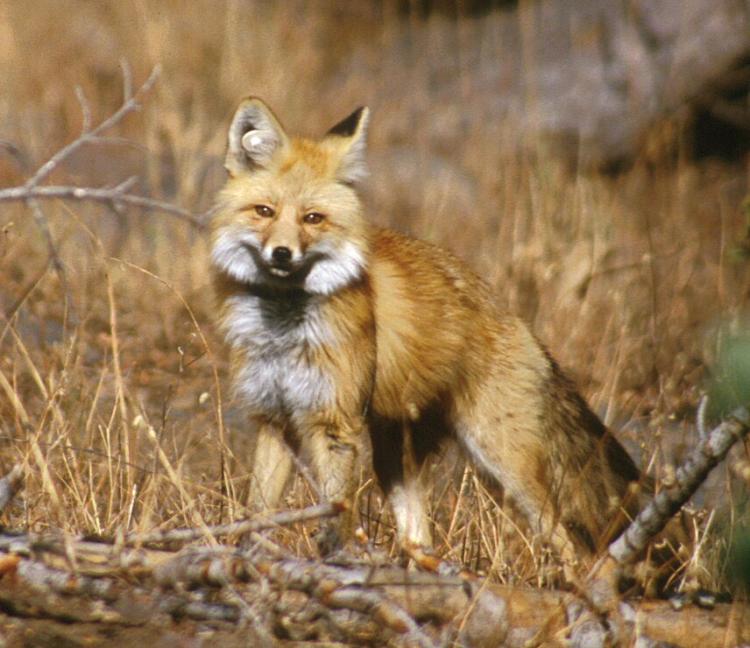
The Sierra Nevada red fox is a montane subspecies of red fox. Red foxes are small canids with slender bodies, elongated snouts, large, pointed ears, and large, bushy tails with a white tip. There are at least three color morphs: red morph animals have a yellowish-reddish brown upper body and tail, white cheeks, throat, and abdomen, and black ear tips and lower legs; the cross color-morph is characterized by grayish-brown fur with dark guard hairs along the back and shoulders; and the black morph animals are all black on the head, torso, and tail with silver guard hairs. The red morph is the most common in red foxes and the cross phase may be more prevalent in mountainous areas.
The U.S. Fish and Wildlife Service recognizes two distinct population segments (DPS) of the Sierra Nevada red fox in the U.S.– the Cascade DPS in the Southern Cascades (south of the Columbia River), and the Sierra Nevada DPS in the Sierra Nevada of California.
Overview
Species Common Name Sierra Nevada Red Fox
Species Scientific NameVulpes vulpes necator
Federal Listing Status Endangered (Sierra Nevada DPS)
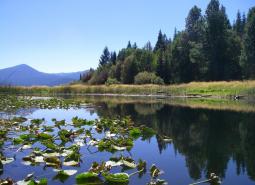
This species is a denning species and requires specific denning habitat in order to complete its life history phases. Sierra Nevada red fox utilize forests with mountain hemlock, alpine and subalpine meadows, and grasslands and volcanic rock. They utilize high elevation meadows and forest habitats with sufficient snow pack. The species is experiencing greater conservation threats at the southern edge of its range in California, so efforts to provide habitat in Oregon are especially helpful.
Limiting factors
Information on Sierra Nevada red fox biology is scant, and therefore much information on threats or environmental stressors is speculative. The species is probably threatened by demographic features associated with small population size. Populations in Oregon are likely threatened by loss of forested habitat, as wells as increased wildfire frequency and intensity and loss of snowpack associated with climate change. Predation, secondary rodenticide poisoning, and vehicle collisions are all identified as potential sources of mortality. Changes in prey availability including snowshoe hare also limit populations. Small fox populations are likely susceptible to extirpation from inbreeding depression, and from stochastic events such as droughts or diseases. Non-native red foxes present potential competition and reservoirs of parasites and disease. Sierra Nevada red fox may also be threatened by increased recreational pressure, which may lead to habituation, human-wildlife conflict, increased disease transmission, and increased risk of road mortality.
Data gaps
• Determine habitat requirements, particularly for natal dens.
• Study Oregon-specific diet and prey abundance.
• Study the role of whitebark pine in Sierra Nevada red fox habitat.
• Refine genetic and taxonomic classification.
• Establish the high mountain habitat components and complexes (quality and quantity) needed by the species in Oregon.
• Determine occurrence and occupancy in Oregon.
• Determine breeding home ranges, summer vs. wintering ranges, movements, dispersal, and habitat connectivity.
• Assess population demographic parameters.
• Determine risk to this high montane species and its prey from climate change.
• Evaluate specific impacts of additional mortality factors (e.g., vehicle strikes, predators).
• Evaluate whether lessened snowpack due to climate change facilitates overlapping ranges of coyotes and Sierra Nevada red fox.
• Evaluate habituation of foxes in overlapping areas of high human use and species’ range. Evaluate how habituation may be affecting survival.
• Evaluate red fox subspecies that trappers collect in close proximity to species’ range to understand movement patterns of non-native red foxes, providing more information on potential risks of non-native introgression.
Conservation actions
• Maintain and/or recruit high-elevation conifer forest and meadow habitat.
• Continue monitoring programs.
• Support data collection efforts to distinguish between red fox populations and assess population contiguity with Rocky Mountain red fox.
• Assess movement and habitat connectivity for the species to inform wildlife passage projects.
• Collect data to inform recreation management to benefit the species.
• Monitor known natal dens for reproduction, and continue to analyze den site characteristics to assist in the protection of volcanic rock, soil, and downed log features that should be maintained.
• Monitor and collect data on vehicle strikes and locations where culverts or other forms of passage across roadways could be implemented.
• Encourage use of carnivore-proof trash disposal in areas of high recreation (e.g., snow parks) to reduce the habituation of foxes and lower the probability of road strikes and poisoning.
Key reference or plan
Forest carnivore research in the Northern Cascades of Oregon (Oct 2012-June 2014): Final Progress Report to Oregon Department of Fish and Wildlife. Read here
Species Status Assessment Report for the Sierra Nevada Distinct Population Segment of the Sierra Nevada Red Fox. Read here
A Conservation Strategy for the Sierra Nevada Red Fox. Read here