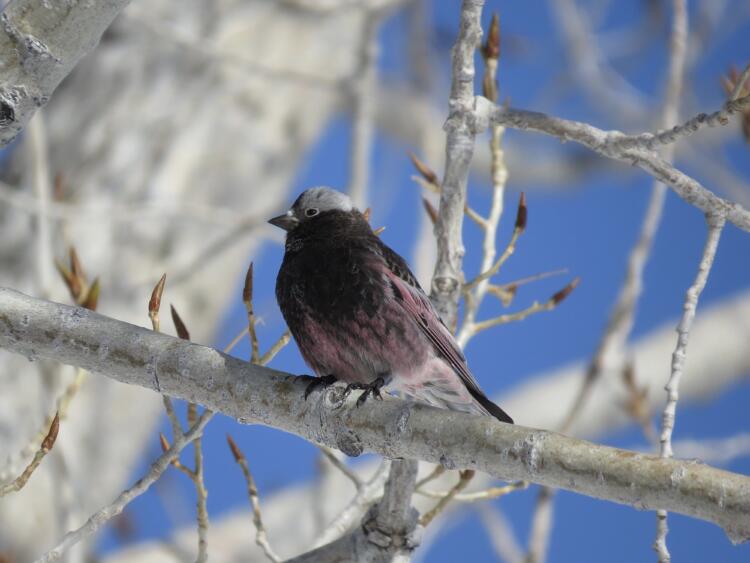
The Black Rosy-Finch, Leucosticte atrata, is a medium-sized, dark-colored finch. It is one of three types of rosy-finches found in North America and is one of the rarest birds that breeds in Oregon. In the summer, it lives high in the mountains of southeastern Oregon, above the tree line and even above where snow stays year-round. In the winter, it moves to lower elevations.
It has a medium-sized bill made for eating seeds. Males and females are similar in size and appearance, but males are more colorful. Male Black Rosy-Finches are a uniform dark brownish-black on the back, chest, neck, and face below the eyes. The belly, rump, and parts of the wings and tail have pink edges. The forehead is black with a silver-gray patch behind it. Their bill is a dull yellow, and their legs are black.
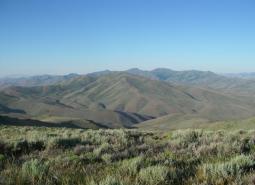
Black Rosy-finches typically breed above treeline in alpine habitat, nesting mostly in cracks and holes in cliffs. They are commonly found on north facing talus or scree slopes above timberline near areas with suitable foraging habitat. In Oregon, breeders found in the Steens Mountains.
Limiting factors
As an alpine breeder, the Black Rosy-finch is vulnerable to impacts from climate change, including habitat loss. The breeding population in Oregon is small and not well connected to the core of the range of the species. In winter, Black Rosy-finches can concentrate at feeders and roosts, making them more vulnerable to impacts including spread of disease, collision with windows, road mortality, and predation by cats.
Data gaps
• Black Rosy-finches are among the least studied of North American birds because of inaccessibility of their alpine habitat and their nest sites on cliffs. Basic information about breeding biology is therefore lacking, particularly as remote habitat is difficult to access.
• Population trends are difficult to determine and verify with current methodology.
Conservation actions
• Identify effective methodology to survey and monitor suitable habitat and population trends.
Key reference or plan
ECOS Environmental Conservation Online System Profile for the Black Rosy-Finch. Read here