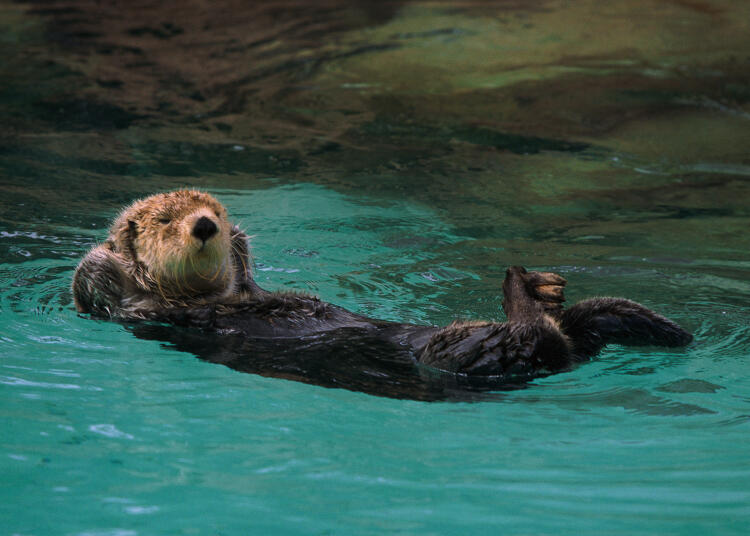
Sea otters are the smallest marine mammal species and live in the nearshore waters along the Pacific Coast of North America, Russia, and Japan. They are members of the Mustelidae family, which also includes weasels, badgers, and wolverines. Their historic range stretched from Hokkaido, Japan around the North Pacific Rim to Baja, Mexico. The population was reduced to just a few hundred animals due to commercial harvest by fur traders between 1742 and 1911. Sea otters have extraordinarily dense fur which traps air, creating an insulating layer next to their skin that keeps it warm in cold water. There are two subspecies of sea otters found in North America: the northern (Enhydra lutris kenyoni) and the southern (Enhydra lutris lutris), with the southern subspecies listed as threatened under the federal ESA. Oregon appears to have been a transition zone where both northern and southern sea otters once mixed before they were extirpated from Oregon. The southern subspecies is smaller than the northern subspecies. Typical lengths for sea otter males are 47 to 56 inches long, with weights typically weighing 49 to 88 pounds. Females are smaller and typical from 45 to 52 inches long, weighing from 31 to 71 pounds. Females tend to live longer than males, with estimated lifespans of 15 to 20 years compared with 10 to 15 years for males. Sea otters primarily live in the marine environment and even give birth in the water, but they do sometimes haul out if sites are protected from predators. Sea otters eat a wide variety of marine invertebrates that include at least 150 prey species, such as urchins, crabs, clams, mussels, abalone, sea cucumbers, tubeworms, and sea snails. Sea otters do not have blubber like other marine mammals and consume up to 20 to 30 percent of their weight per day to maintain the high metabolism needed to stay warm. They are not migratory, have small home ranges, and forage at depths less than 130 feet.
Overview
Species Common Name Sea Otter
Species Scientific NameEnhydra lutris
Federal Listing Status Threatened (southern subspecies)
Sea otters need ample marine invertebrate prey within relatively shallow waters associated with nearshore habitats including rocky reefs, kelps forests, and estuaries.
Limiting factors
Oil spills pose a severe threat to sea otters due to their dense fur, which provides insulation. They are susceptible to various forms of pollution, including harmful algal blooms, pesticides, and other toxins that can accumulate in their food chain or that carry diseases and pathogens. Sea otters are vulnerable to the impacts from climate change on their habitat, including kelp forests and eelgrass beds, as well as on their prey resources. Lethal shark attacks are thought to be a factor limiting the southern sea otter from expanding northward.
Data gaps
• Continue to increase knowledge on the environmental factors that could drive population expansion of northern and southern sea otters to Oregon waters.
• Enhance understanding of the ecological and economic cost-benefit trade-offs of reintroduction, including its impacts on Tribes, coastal communities, recreational and commercial fisheries, other ocean users, and regional economies.
• Determine the climate resiliency of associated habitat types in Oregon’s nearshore and estuaries to evaluate potential reintroduction sites.
• Assess and monitor Oregon-specific prey availability needed for sustaining varying population sizes.
• Evaluate local natural hazards (e.g. sharks) and human-caused hazards (potential human impacts on sea otters) at sites.
Conservation actions
• Record and communicate any observations of the species in Oregon.
• Address data needs to effectively evaluate habitat suitability to develop a comprehensive reintroduction plan.
• Protect critical habitat from degradation and development, including kelp forests, eelgrass beds, and estuaries.
• Prevent pollution of coastal and marine waters, including oil and chemical contamination, sewage and stormwater runoff, and effects from climate change including ocean acidification.
• Explore potential actions for sea otter recovery under the Oregon Endangered Species Act (ORS 496.171 through 496.192).
• Engage Oregon partners to implement outreach/education activities.