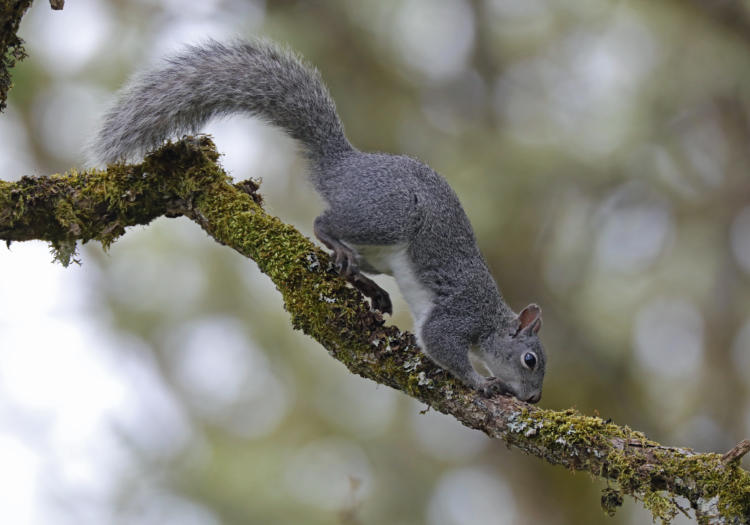
The western gray squirrel is the largest native tree squirrel in its range, with adults measuring 500 – 615 mm in length and weighing 520 – 942 g. Tail length ranges from 240 – 309 cm.The dorsal side of body is a silvery-gray with white-tipped hairs, and the ventral side is white. The tail is gray on the ventral and dorsal sides with white-tipped hairs and the backs of ears are rusty brown. Adults do not show sexual dimorphism.
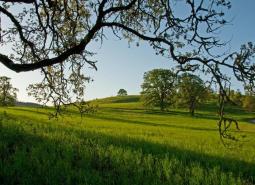
In the Willamette Valley, western gray squirrels utilize oak woodland and savanna, mixed oak-pine-fir woodlands, and older oak trees with large limbs. The species is generally confined to remnant habitat patches within this otherwise highly developed ecoregion, although some populations may be associated with hazelnut and other nut farms. Continuous canopy facilitates movement and dispersal. Proximity to water is another habitat need.
Limiting factors
Oak woodlands (often including or adjacent to pine and fir) are primary western gray squirrel habitat in the Willamette Valley. Oak woodlands are threatened by altered disturbance regimes (e.g., vegetation changes due to fire suppression). This contributes to increasing competition from conifers. Oak woodland habitat is also significantly threatened by habitat loss and fragmentation from urban development and conversion of habitat for agricultural uses. Other threats include road mortality, damage control efforts, and displacement by and competition with non-native squirrels such as eastern gray squirrels and eastern fox squirrels.
Data gaps
• Assess Western gray squirrel population size, trends and other demographic data for Oregon.
Conservation actions
• Address population declines by reducing habitat loss, degradation, and fragmentation as well as limiting competition from introduced non-native squirrel species.
• Work with private landowners to maintain and restore oak and mixed oak/pine/fir woodlands, especially large patches.
• Work with landowners experiencing damage to trap and relocate squirrels.
• Maintain continuous canopy within 200 feet of nest sites.
• Where possible, maintain continuous canopy of oak woodland habitat over roadways to help prevent road mortality.
• Maintain or plant ‘mast’ species such as Oregon white oak and California hazel.
• Maintain older trees with large limbs.
• Maintain connectivity to limit isolation of populations.