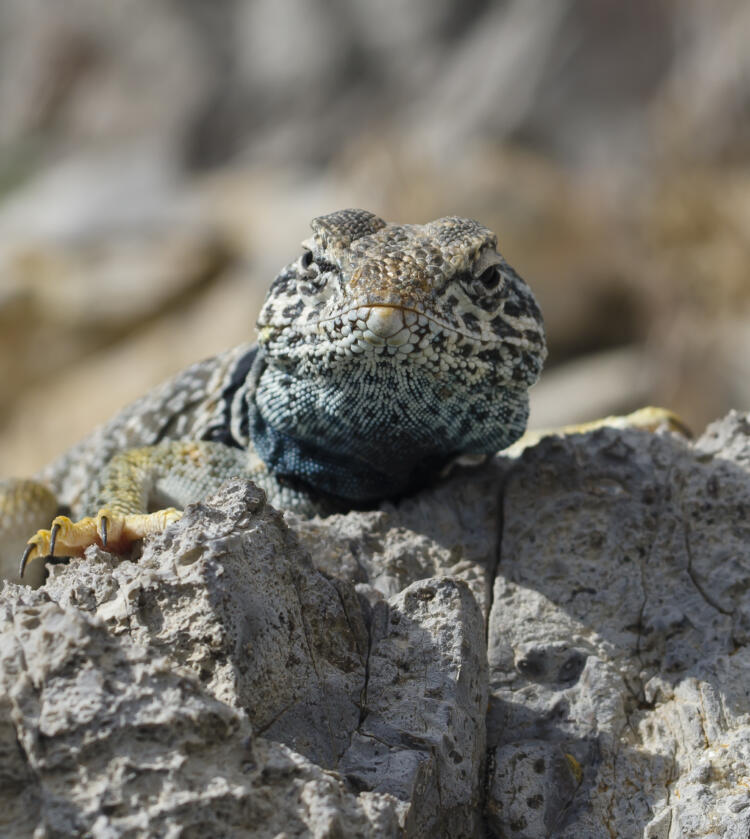
Great Basin collared lizards (formerly Mojave black-collared lizards) are medium sized with prominent rings around their necks, gray to brown bodies with pale bellies. Light spots cover most of the body. At the tail, the spots form a reticulated pattern.
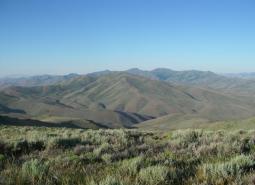
The Great Basin collared lizard is desert-dwelling and occupies sparsely vegetated areas, rocky areas on hillsides, rocky plains with scattered boulders, and canyons.
Limiting factors
Occurrence of Great Basin collared lizard is low in Oregon within its restricted range, but the species can be locally abundant in suitable habitat. The species is vulnerable to habitat destruction, habitat degradation (including by invasive species, fire, energy development), and overcollection or illegal take. They are identified as particularly sensitive to combined climate change concerns (Mims et al. 2018). Off-road vehicle recreation in occupied areas increases risk of direct mortality and likely impacts habitat suitability. Energy development may negatively impact suitable habitat.
Data gaps
• Assess population occurrence data and trends.
• Determine occupied sites and habitat associations.
• Assess implications of various land uses on suitable habitat.
• Identify habitats critical to persistence in Oregon.
• Assess status of population and genetic connectivity.
• Determine current occupancy.
Conservation actions
• Maintain and enhance habitat.
• Control invasive species that threaten habitat suitability.
• Investigate impacts of various land uses on suitable habitat.
• Address overcollection and illegal trade.
• Address impacts of off-road vehicles.
Key reference or plan
Mims et al. 2018. Functional and geographic components of risk for climate sensitive vertebrates in the Pacific Northwest, USA. Read here
Crother, B. I. (editor). 2017. Scientific and standard English names of amphibians and reptiles of North America north of Mexico, with comments regarding confidence in our understanding. 8th edition. SSAR Herpetological Circular 43:1-104. [Updates in SSAR North American Species Names Database at: https://ssarherps.org/cndb]