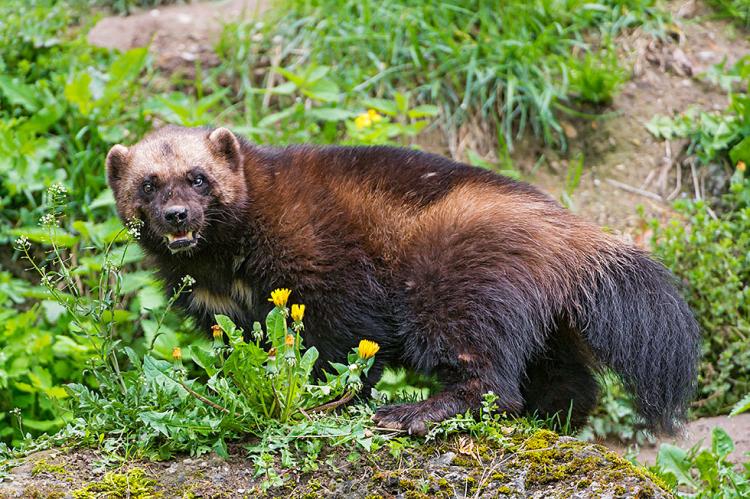
The wolverine is the largest terrestrial member of the weasel family (Mustelidae). It is often described as bear-like due to its mostly dark brown coloring, thick body, short ears, and broad head. Wolverines are a sexually dimorphic, mid-size carnivore with males weighing 10 to 18 kg and females 7 to 13 kg. The average length of an adult ranges from 63-99 cm from head to tip of tail. The hair on the tail and back of the body is longer and bushier than fur at the head and front of body. The feet of a wolverine are large (7-11 cm in length) in proportion to body size with large, curved claws to assist with climbing trees and traveling through soft, deep snow. Wolverines typically have lighter pelage markings on their face, along their sides from shoulder to base of tail, and ventral markings on their chest or throat. These markings vary by individual, and can range from barely discernable to strikingly silver. Ventral markings on the chest and throat are unique to each wolverine and can reliably be used to identify individuals.
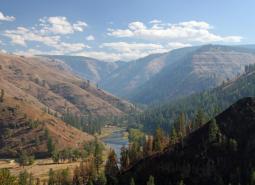
Wolverines mostly use subalpine and alpine forests for foraging and steep, snowy habitat above timberline for dens. Non-breeding individuals may travel through a range of habitats including lowlands. There is a need for conservation-focused planning and development in lowland valleys to allow for movement between high-elevation habitats.
Limiting factors
Wolverines live at naturally low densities due to large area requirements. Wolverines have low reproductive rates. They are sensitive to habitat fragmentation, roads and human activity, and climate change. Warming climate conditions are impacting the depth and persistence of snowpack in alpine and subalpine forests, impacting the availability of denning and maternity sites.
Data gaps
• Study population dynamics in relation to dispersing individuals and neighboring states with established populations.
• Investigate seasonal habitat requirements.
Conservation actions
• Develop management approaches, considering low density and large home ranges.
• Conduct population monitoring in suitable habitats using hair snares, telemetry, and remote camera traps throughout the Wallowa Mountains, Cascade Mountain Range and opportunistically wherever wolverines are detected.
• Conduct outreach to inform the public about the species.
• Take precautions to avoid accidental trapping.