Photo Credit: Craig Hayslip, OSU Marine Mammal Institute
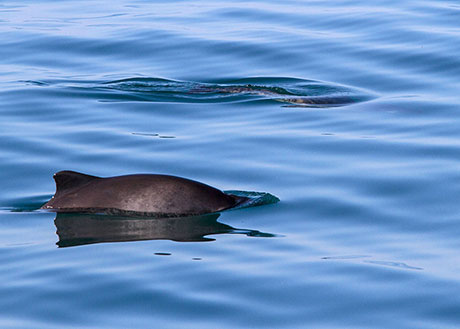
Harbor porpoise are among the smallest of marine mammals. They have a small robust body that is dark grey on the upper half and white on the bottom half. They have a blunt rounded head with a grey “chinstrap”. The most distinguishing feature of harbor porpoises as they surface, is their short triangular dorsal fin. They reach sizes of about 4.6 to 6.2 feet in length and can weigh up to 170 pounds, but most weigh less than 135 pounds.
Harbor porpoises eat a variety of prey, mainly small schooling fish, but may also eat octopi and squid. They live in waters generally less than 656 feet deep in Oregon waters, often found very close to shore and in estuaries.
Limiting factors
Harbor porpoise are sensitive to noise. Like other marine mammal predators, they can bioaccumulate toxins and plastics from their prey. Chemical pollution, including oil spills, can be a threat. They live in the nearshore waters of Oregon, where they are subject to many human activities and threats.
Data gaps
• Environmental factors that drive distribution in Oregon waters.
• Vulnerability to climate change impacts.
• Evaluate impacts of renewable energy development on this species.
Conservation actions
• Minimize effects of vessel disturbance.
• Reduce chemical and plastic pollution in the marine environment.