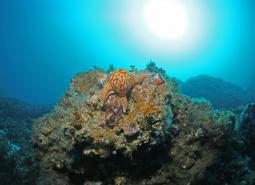
The striped sun star is a large (up to 58 cm diameter) sea star with 8 to 12 (typically 10) relatively long (up to 23 cm) slender rays. The aboral surface is typically yellow-orange or red, and prominent gray, blue or purple stripes radiate out from the center of the disc to the tip of each ray. They generally inhabit rocky, sandy, and muddy areas in subtidal areas (0 to 30 m; down to a maximum depth of 610 m), but they also sometimes occur in the low intertidal zone. Juveniles have been observed within beds of tube worms (Phyllochaetopterus). They feed upon a diversity of prey items including sea cucumbers (Cucumaria miniata, Cucumaria curata, Eupentacta quinquesemita, Eupentacta pseudoquinquesemita, Psolus chitonoides), sea pens, tunicates, and brachiopods. Striped sun stars are broadcast spawners, and mature females spawn large yolky eggs that are buoyant and float upwards through the water column after release. The embryos develop into large, short-lived lecithotrophic larvae that subsist on yolk materials while they disperse in ocean currents for a period of about 8 to 10 days. Striped sun stars are preyed upon by congeneric morning sun stars (Solaster dawsoni) and by the large predatory snail (Fusitriton oregonensis). Populations of striped sun star (and many other species of asteroids) were decimated throughout their range by Sea Star Wasting Syndrome (SSWS) which is a contagious condition that results in body lesions, tissue decay, rapid disintegration, and death. Sea stars along much of the North American Pacific Coast experienced massive mortality from 2013 to 2015 due to SSWS, and the die-off has persisted at low levels up to the present. Striped sun star largely disappeared from its normal habitats in marine waters off the coast of Oregon over 2016 to 2020, and individuals have not been reported from Oregon waters for several years. It is estimated that striped sun stars have a life span of about 10 to 15 years. The biogeographic range extends from Japan to the Bering Sea and Aleutian Islands (AK) and along the west coast of North America to Salt Point (CA).
Overview
- Species Common Name Striped sun star
- Species Scientific Name Solaster stimpsoni