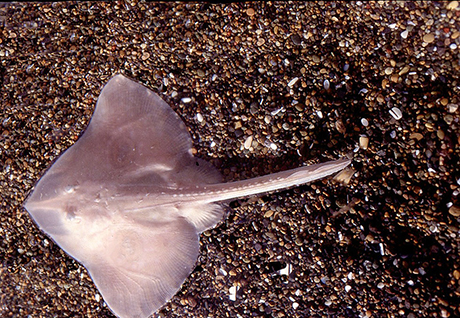
Big skate come in a variety of dark colors on their topside, including brown, gray, olive and black, and are whitish on the bottom. They often have both bright dots and dark mottling. Big skate have pointed snouts and two “eye spots”, one on each of their pectoral fins. Their bodies are flattened. They live on the bottom in sandy or muddy habitats, both in estuaries and off the coast. They can grow to 8 feet long and weigh at least 200 pounds. They have a cartilaginous skeleton. Eggs are fertilized inside the mother then encapsulated in an egg case which is deposited on the sea floor where embryos develop and hatch. Egg cases can be up to a foot long and hold up to 7 embryos, but 3 to 4 is more typical. Big skates are slow to mature, with females maturing at 12 to 13 years and males at 7 to 8 years. They can live at least 30 years. Big skate eat worms, shrimp, crabs, and a variety of fish species. They will also eat snails, amphipods, isopods, and mysids.
Overview
- Species Common Name Big skate
- Species Scientific Name Berignraja binoculata