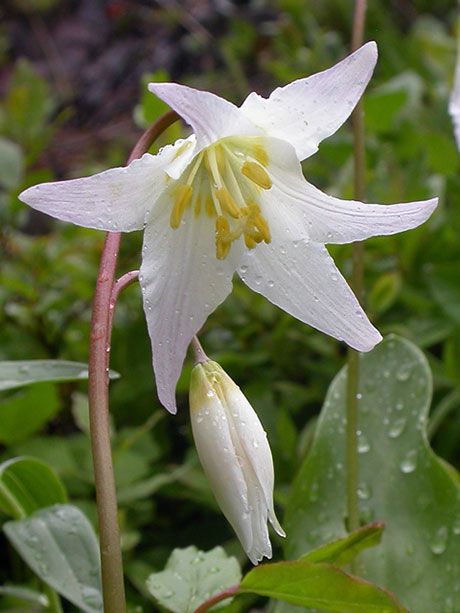
Coast Range fawn lily is a perennial arising from a corm 2-5.5 cm long by 0.8-1.5 cm wide, which produces new cormlets laterally. Leaves are uniformly deep green or faintly mottled with brown or white. Non-flowering plants bear a single leaf, 6-8 cm long by 45 cm wide, the broad ovate-lanceolate blade usually abruptly narrowed to a slender, nearly wingless petiole. Flowering plants bear two more or less prostrate leaves 7-20 cm long by 2-4 (-8) cm wide, the narrowly lanceolate blade, often with wavy margins, gradually narrowed to a short, winged petiole. Flowers are nodding, number 1-2 (-4), and are borne on a scape 10-30 cm tall. The perianth is strongly reflexed in bright sunlight to only slightly spreading in low light conditions. Tepals are lanceolate to narrowly elliptic, 2-4 (-5) cm long, inner tepals more or less white and auriculate at the base, outer tepals more or less white and tinged (often strongly) with pink, particularly abaxially and along the midline; both inner and outer tepals have a yellow band at the base, become more pinkish throughout with age, and are darker on abaxial surfaces. Stamens are 1.3-2.2 cm long, the filaments white, flattened, linear to lanceolate, and 0.5-2 mm wide, the anthers yellow. The style is white, 1-3 cm long, the stigma deeply divided with slender, usually recurved lobes 2-4 mm long. Capsules are obovoid to oblong, 2-5 cm long.
Overview
- Species Common Name Coast Range fawn lily
- Species Scientific Name Erythronium elegans
- Federal Listing Status Species of Concern
- State Listing Status Threatened