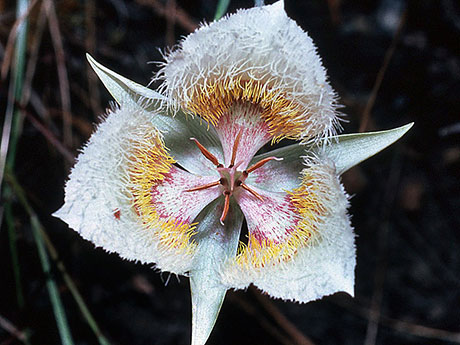
Crinite mariposa lily is a bulbous perennial with a single, more or less erect basal leaf up to 30 cm long and 0.3-0.7 cm wide. The outer surface of the leaf is dark green, shiny, and glabrous, the inner surface densely hairy with rows of blunt-ended hairs on raised veins. The flowering stem is erect to flexuose, 15-25 cm tall, with one to several bracts 2.5-3 cm long. Stalks bear 1-7 three-petaled, cup-shaped flowers on erect pedicels. Sepals are ovate acuminate, approximately 2 cm long by 0.8 cm wide. Petals are densely hairy, broadly obovate, 2.5 cm long or more, and white with pinkish-red striations from base to gland. The gland is deeply impressed, green at the inner base, with a membranous scale covered with minute translucent rod-like hairs. Petal hairs are yellow just above the gland and grade to white at the petal tips. Petal edges are fringed and hairy. Anthers are apiculate, 0.3-0.7 cm long and reddish brown; filaments are approximately 0.7 cm long. Capsules are nodding, elliptic elongate, 3-winged, and 3-4 cm long by 1.5 cm or more wide, with a 0.4 cm recurved “style.”
The crinite mariposa lily is found in meadow, leaf litter, and moss habitat between 840-2780 feet elevation. This species occurs on serpentine soils in transition zones between coniferous forests and grass-shrub meadows.
Limiting factors
This rare endemic species is vulnerable to bulb collecting and flower picking. Grazing, seed predation, shrub and tree encroachment, competition from invasive weeds, and fire suppression are among other threats. The species is also moderately vulnerable to climate change, due to predicted modifications to hydrologic regimes and habitat availability.
Data gaps
Develop propagation and transplanting protocols. Conduct reproductive biology studies to determine causes of low fecundity. Investigate soil/microsite mechanisms causing endemism to serpentine soils.
Conservation actions
Survey potential suitable habitat to inform establishment of new populations. Conduct long-term monitoring of known populations. Manage grazing and recreational activity in sensitive areas.
Key reference or plan
A Conservation Agreement to protect crinite mariposa lily and its habitat on lands managed by the Roseburg District Bureau of Land Management was updated in 2020. A report on population trends and threats was published in 2024 (Estrada, L. and S. Harris. 2024. Evaluation of population trends and potential threats to a rare serpentine endemic, Calochortus coxii (crinite mariposa lily). 2023 Annual report. Prepared by Institute for Applied Ecology for the USDI Bureau of Land Management, Roseburg District. Corvallis, Oregon.)