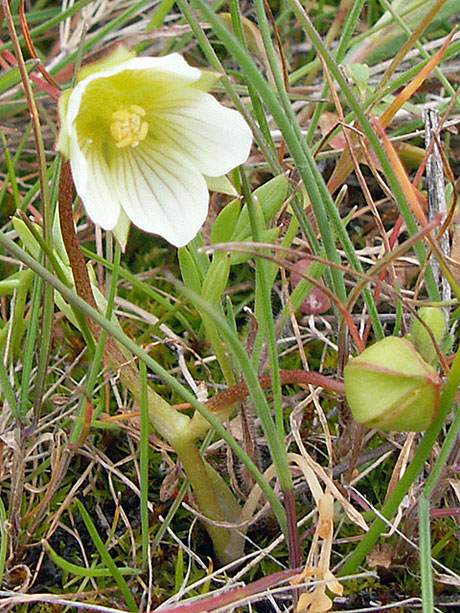
Dwarf meadowfoam is an annual herb with herbage glabrous throughout. Stems are simple or sparingly branched near the base, ranging from 5-10 cm high. Leaves are 1-5 cm long and are pinnately divided with linear to oblanceolate leaflets 38 mm long. Peduncles are stout, glabrous, and 2-4 cm long. Sepals are broadly lanceolate, acute, 6-10 mm long, and are glabrous to sparse woolly hairy within and glabrous without. Petals are white, oblong, rounded, and less than or equal to the sepals in length. Each flower produces 3-5 ovoid nutlets that are wrinkled below. Depending on the rains and temperature, the taxon can be found flowering from the beginning of March to mid-April.
Overview
Species Common Name Dwarf meadowfoam
Species Scientific NameLimnanthes pumila ssp. pumila
Dwarf meadowfoam typically grows along the edges of deep vernal pools. This species is associated with ancient basalt lava flows on Upper and Lower Table Rocks in Jackson County, above 1950 feet.
Limiting factors
Habitat loss and degradation, including impacts of trail construction and maintenance and recreation, threaten this species. Dwarf meadowfoam is extremely vulnerable to climate change because of limited dispersal capabilities, predicted altered hydrologic regimes, limited habitat availability, and predicted increased competition with invasive plants.
Data gaps
Develop seed germination, cultivation, and transplanting/introduction protocols. Conduct pollination studies. Research annual population variability and estimate long-term trends.
Conservation actions
Minimize impacts from human recreation and maintenance. Continue population monitoring. Note: this plant occurs only on federal land.
Key reference or plan
A Recovery Plan for listed species of the Rogue and Illinois Valleys was released in 2012 by the U.S. Fish and Wildlife Service (https://ecos.fws.gov/docs/recovery_plan/Rogue&Illinois%20Valley%20Final%20Recovery%20Plan%20031913.pdf).