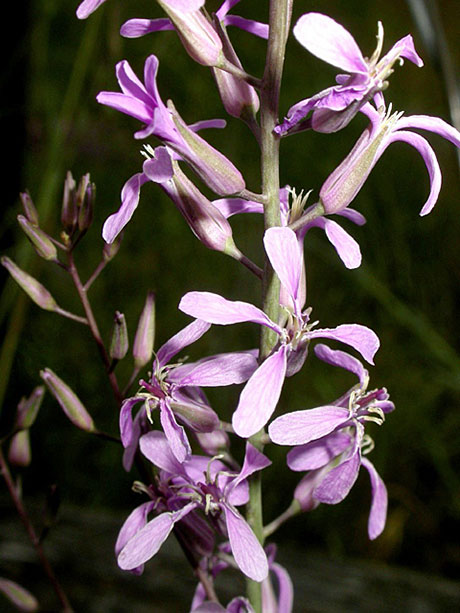
Howell’s spectacular thelypody is an herbacious biennial that grows 3-7 dm tall. During the first growing season, this species typically forms a rosette, with wavy-margined leaves growing 2-5 cm in length. As with many biennials, Howell’s spectacular thelypody usually reproduces in its second year. The flowering stalk’s auriculate cauline leaves have smooth edges and are shorter and narrower than the basal leaves. The slender, elongate racemes hold numerous pinkish-purple to purple flowers on short (2-5 mm long) pedicels. Each flower has four ribbon-like petals that range from 1.6-2 cm in length. Sepals are purplish and 8-9 mm long. Stamens are much shorter than the petals, and filaments are paired. Fruits are long, slender pods (siliques), typically 3-6.5 cm long. Howell’s spectacular thelypody starts flowering in late May and continues through July. Fruits start to mature by mid-July.
Overview
Species Common Name Howell's spectacular thelypody
Species Scientific NameThelypodium howellii ssp. spectabilis
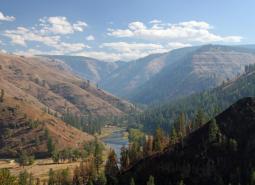
Howell’s spectacular thelypody occurs in low-elevation (3000-3500 feet) river valleys and moist, alkaline plains. This species is often found at the intersection of black greasewood and riparian habitat. Howell’s spectacular thelypody may be dependent on seasonal flooding.
Limiting factors
This narrowly-distributed species is endemic to the Baker-Powder drainage. Much of this species’ habitat has been converted to agricultural uses. Competition from invasive plants, changes in hydrology, grazing pressure, and mowing during the growing season have also adversely affected Howell’s spectacular thelypody. The species is extremely vulnerable to climate change, particularly due to predicted alterations to hydrologic regimes.
Data gaps
Develop seed germination and propagation protocols. Improve understanding of life history, growth requirements, and general ecology. Assess genetic diversity.
Conservation actions
Locate protected sites in potential habitat. Create new populations. Minimize grazing and mowing during the growing season at priority locations. Control key invasive plants. Continue voluntary cooperative efforts with private landowners. Collect and store seeds. Revise the 2002 Haines Rodeo Thelypody Mitigation Site Management Plan.
Key reference or plan
A U.S. Fish and Wildlife Service Recovery Plan (https://ecos.fws.gov/docs/recovery_plan/020603.pdf) was released for Howell’s spectacular thelypody in 2002. A management plan was created for the Haines Rodeo Thelypody Mitigation Site in November of 2002. The most recent 5-Year Review was published in 2023 (https://ecosphere-documents-production-public.s3.amazonaws.com/sams/public_docs/species_nonpublish/10473.pdf).