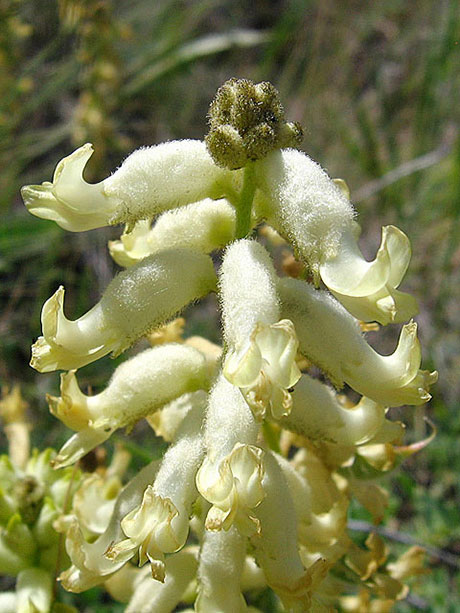
Lawrence’s milkvetch is a taprooted perennial 20-40 cm high. Stems are clustered, erect or decumbent at the base, and canescent with short crisped pubescence. Leaves are 3-5 cm long, with short petioles. Leaflets number 11-17, are linear to cuneate with obtuse or emarginate apices, 0.6-1.0 cm long, and woolly pubescent. Many-flowered racemes are borne on peduncles much longer than the leaves. The calyx is about 1.0 cm long and woolly pubescent, the pubescence mostly whitish with scattered dark hairs. The corolla is cream or yellowish, about 1.5 cm long. The pods are obliquely ovate-oblong and lunately incurved, the stipe 0.5-1.5 cm long, the body 0.8-1.5 cm long, moderately compressed, and villous (or glabrous in some variant populations*) with prominent sutures, the valves becoming leathery and impressed-reticulate.
Overview
- Species Common Name Lawrence's milkvetch
- Species Scientific Name Astragalus collinus var. laurentii
- Federal Listing Status Species of Concern
- State Listing Status Threatened