
Oregon semaphore grass is a perennial arising from slender rhizomes with purplish red scales and long soft internodes. The culms are erect, soft and spongy, and 55-90 cm tall. Sheaths are overlapping and closed for 3/4 their length, the lower sheaths loose, purplish red, and nearly smooth, the upper ones scaberulous and striate. Ligules are white, lacerate, membranous, and 4-5 mm long. Leaf blades are erect, flat, slightly scaberulous on the upper surface and sometimes also the lower, abruptly narrowed to an acute, mucronate apex, and 8-18 cm long by 0.4-0.7 cm wide, the uppermost blades reduced. Racemes are somewhat erect with slender axes 6-20 cm long bearing 6-8 spikelets on 2-12 mm-long pedicels. Spikelets are erect or ascending, spreading toward one side of the raceme, 2-4 cm long, and green tinged with purple, each bearing 7-14 flowers, the upper florets pistillate, the lower perfect. Glumes are pale and membranous, unequal, and 2-4 mm long; rachilla joints are 2-3 mm long; lemmas are strongly 7-nerved, 5.5-7 mm long by about 3 mm wide, with an erect awn 6-10 mm long at the apex; paleas are approximately equal to the lemmas, each of the two palea keels bearing a slender, erect to spreading awn 2-7 mm long attached about onethird from the base of the palea; anthers are brown to purple, 4 mm long.
Overview
- Species Common Name Oregon semaphore grass
- Species Scientific Name Pleuropogon oregonus
- State Listing Status Threatened
Ecoregions
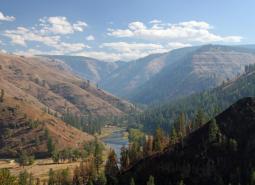
Blue Mountains
Located in NE Oregon, the Blue Mountains ecoregion is the largest ecoregion in the state. It provides a diverse complex of mountain ranges, valleys, and plateaus that extend beyond Oregon into the states of Idaho and Washington.
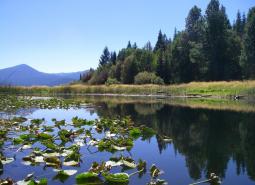
East Cascades
The East Cascade ecoregion extends from the Cascade Mountains' summit east to the warmer, drier high desert and down the length of the state. This ecoregion varies dramatically from its cool, moist border with the West Cascades ecoregion to its dry eastern border, where it meets sagebrush desert landscapes.