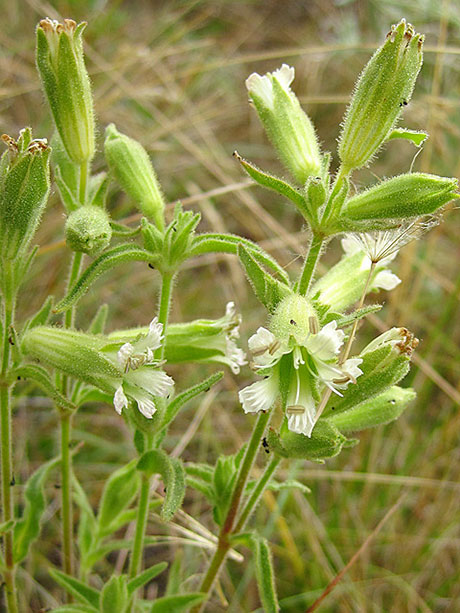
Spalding’s campion is a perennial with one to many shoots growing from a branched, woody caudex. It is viscid-tomentose throughout, with erect leafy stems, simple or strictly branched, 20-60 cm tall. The nodes are large, with 2 sessile, proximally connate leaves per node. Leaf blades are ovate to lanceolate with an acute apex, 3-7 cm long by 0.5-1.5 cm wide, and largest at mid stem. The narrow, strict inflorescence is usually leafy with many crowded flowers. The calyx is tubular-campanulate, obscurely 10veined, and about 1.5 cm long at anthesis, with narrowly lanceolate lobes 0.3-0.6 cm long. The petals are greenish to white, with a shallow terminal notch and 4 (-6) appendages. The petal claws equal the calyx, the petals not exceeding or barely exceeding the calyx lobes. Capsules are ellipsoid, slightly longer than the calyx, and borne on a short stipe. The yellowish brown seeds are reniform, wrinkled with alternating ridges and furrows, inflated, and approximately 0.2 cm long.
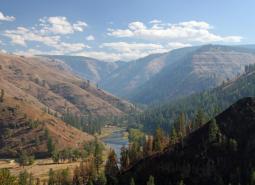
Spalding’s campion occurs in moist bunchgrass-dominated grasslands or sagebrush-steppe communities with deep soils.
Limiting factors
Invasive plants, especially knapweeds, can displace Spalding’s campion. The species is also threatened by human development, grazing and trampling, changes in fire regimes, off-road vehicle use, and herbicide spraying. Spalding’s campion is highly vulnerable to climate change, particularly because of predicted increased temperatures.
Data gaps
Distribution on private land is not well documented. Research responses to site-specific stressors including grazing, fire, and invasive plants.
Conservation actions
Control invasive plants. Limit grazing in late summer when Spalding’s campion is in bloom. Develop partnerships to protect core habitat. Continue monitoring populations. Collect seeds for storage and grow out for outplanting.
Key reference or plan
A U.S. Fish and Wildlife Service Recovery Plan (https://ecos.fws.gov/docs/recovery_plan/071012.pdf) was released for Spalding’s campion in 2007.
5 Year Review (2020) : https://ecosphere-documents-production-public.s3.amazonaws.com/sams/public_docs/species_nonpublish/945.pdf