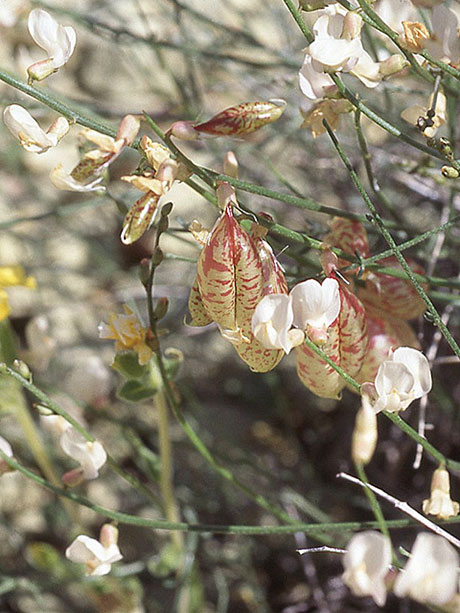
Sterile milkvetch is a perennial species 7-15 cm tall, with stiff, wiry stems arising singly or two or three together from creeping rhizomes. Stems are short-strigose and branched, the branches often incurved. Leaves are 2-9 cm long, the rachis elongated well beyond the leaflets. Leaflets are arranged in scattered pairs of 3-5, are linear to linear-elliptic, 1-5 mm long, and strigose on both faces. Racemes are very slender, curved, and loosely 1-5 flowered. The calyx is campanulate, 2.5-4 mm long, with very short deltoid teeth. The corolla is pale yellowish white to pink and 8-10 mm long. The pendulous, obliquely obovoid pods are inflated and papery, glabrous, translucent, purple mottled, and 2-2.5 cm long.
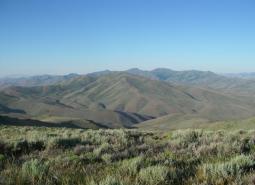
Sterile milkvetch is endemic to the Owyhee Uplands. This species occurs on bluffs along the Owyhee River, in bare gravelly and clay soils derived from weathered volcanic ash.
Limiting factors
Grazing, mining activities, off-road vehicle use, seed predation by insects, and invasive plants are among threats to this species. Plants produce few flowers, fruits, and seeds.
Data gaps
Conduct seed collection focused on capturing potential genetic diversity. Develop propagation and transplanting protocols. Document population trends and reproduction rates
Conservation actions
Protect or fence populations on public land to reduce impacts from off-road vehicles and grazing. Conduct long-term monitoring. Limit range improvement projects in sensitive areas. Collect and bank seed as insurance against local extirpation or extinction and to use in ex-situ research.