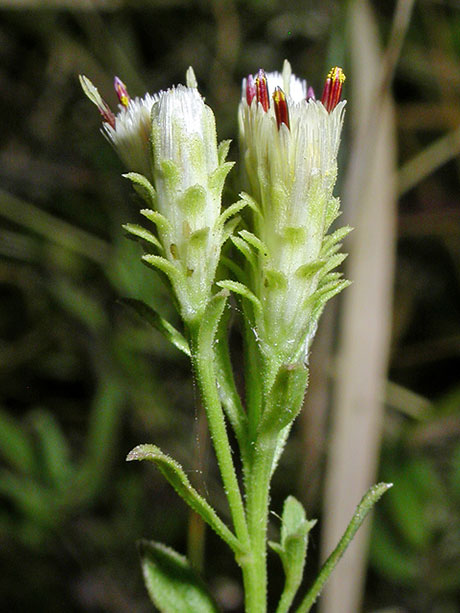
White-topped aster is a perennial herb from slender creeping rhizomes, with generally unbranched stems topped by terminal clusters of flowering heads. Flowering stems are 10-30 cm tall, non-flowering stems about half as tall. Plants are glabrous except for scabrous-ciliolate leaf margins. Leaves are alternate and evenly distributed along the stem, oblanceolate, tapering to an essentially sessile base, with the upper and lowermost leaves reduced and the largest leaves (2.5-3.5 cm long) occurring along the center third of the stem. Flowers are arranged in compact clusters of 5-20 small heads. Ray flowers are typically two (1-3), 0.1-0.3 cm long, white, and shorter than the pappus; disk flowers are mostly 9-21 and are white to pale yellow with purple anthers. Involucres are 0.7-0.9 cm high and narrow, the bracts imbricate in several series, with a strong midrib or slight keel, chartaceous below and with spreading light green herbaceous tips.
White-topped aster occurs in open grasslands, including seasonally-wet prairies and oak savannah.
Limiting factors
Primary threats to white-topped aster include habitat loss and habitat degradation due to lack of fire, as well as competition from invasive plants. Overspray of herbicides may also harm this species. White-topped aster is moderately vulnerable to climate change, primarily due to its limited dispersal ability, predicted increased variability in temperatures, and its primarily asexual reproduction and associated presumed low genetic variation.
Data gaps
Conduct pollinator studies. Develop a seed-sowing protocol.
Conservation actions
Maintain or restore grass-dominated habitat. Control key invasive plants. Use mowing or prescribed fire to control brush and trees. Maintain populations in roadsides and ditches. Collect and store seeds.
Key reference or plan
A U.S. Fish and Wildlife Service Recovery Plan for prairie species of western Oregon and southwestern Washington (https://ecos.fws.gov/docs/recovery_plan/100629.pdf) was released in 2010 and addresses conservation needs of white-topped aster.