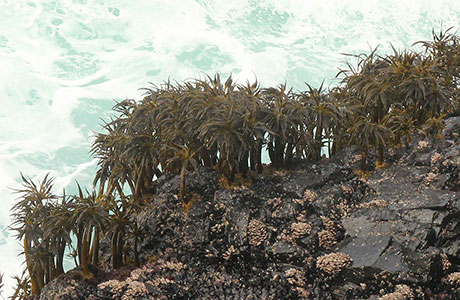
Sea palm is a brown alga that only lives in the middle and upper intertidal zones on wave-exposed rocky shores. It has a tough stem-like hollow stipe that reaches about 50-75 cm tall that keeps it upright even when it is exposed to the air when the tide is low. It is topped with leaf-like blades making it look like a small palm tree from which it gets its name. A tough root-like structure called a holdfast anchors it to the rocky intertidal shore. Sea palms often grow in patches that vary in size. The blades absorb dissolved nutrients and water directly from seawater when submerged, unlike vascular plants that absorb water and nutrients from the soil through their roots. Sea palm is a brown alga that, like all kelp species, alternates generations. The large sporophyte generation that has two sets of chromosomes is what we see in the rocky intertidal zone. Starting from a fertilized egg in February or March this generation grows quickly and is a prominent part of the wave exposed rocky intertidal shoreline throughout the spring and summer. The spores are released in late summer dripping down onto the rocky substrate at low tide and sticking to the substrate. Dispersal of spores appears to be limited to about 3-10 feet and patches of sea palm can persist in the same location year after year. Spores that are successful germinate into the microscopic gametophyte generation of sea palms, with one set of chromosomes, that produces sperm and eggs. Very little is known about the microscopic gametophytes that grow from the spores, but sea palm eggs are immobile and release a chemical cue called a pheromone that attracts the mobile sperm, but only at very close range and new areas where sea palms grow generally are found very close to existing patches of sea palms.
Overview
- Species Common Name Sea Palm
- Species Scientific Name Postelsia palmaeformis