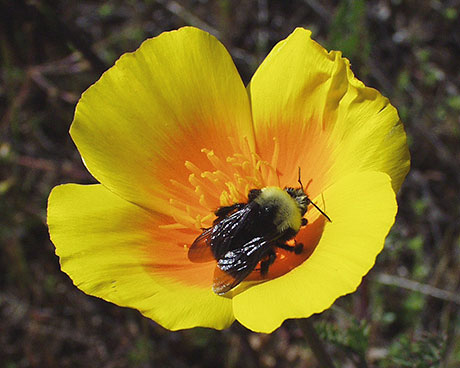
Bombus franklini is readily distinguished from other bumble bees in its range by the extended yellow on the anterior dorsal side of the thorax which extends well behind the wing bases and forms an inverted U-shape around the central patch of black, lack of yellow on the abdomen, yellow on the vertex (top of the head), and white on the fifth tergal (dorsal abdominal) segment. Bombus franklini queens are 22-24 mm in length, the worker is 10-17 mm in length.
Franklin’s bumble bees need a sufficient supply of nectar and pollen throughout the colony season. They use a variety of flowering plants, including lupine, California poppy, horsemint, and penny-royal. These bees probably nest underground in abandoned rodent borrows or, occasionally, in clumps of grass. Suitable overwintering sites for the queens may include soft, undisturbed soil or leaf litter and other debris.
Limiting factors
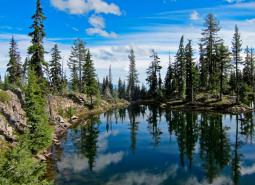
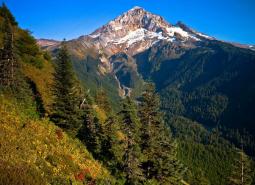
Franklin’s bumble bees are vulnerable to habitat loss and alteration. May be limited by the presence of undisturbed grassland. Fire suppression contributes to loss of meadow habitat. Disease, pesticide applications, potential competition with honey bees for floral resources, and climate change present additional threats.
Data gaps
Monitor historical sites. Obtain estimates of remaining population. Evaluate pathology and control of Nosema bombi [Microsporidia] and other potential disease organisms (such as Locustacrus buchneri [Acarina] and Crithidia bombi [Protozoa]). Determine susceptibility of commercially-reared and wild bumble bee species to pathogens.
Conservation actions
Continue to survey historical sites to determine species status. If B. franklini is found, protect important bumble bee habitat and manage to include habitat needs including food resources and nesting habitat. Limit the spread of disease by reducing exposure to commercial bumble bees and honey bee colonies.
Key reference or plan
Clackburn, M. and R. Hatfield. 2019. Interagency Special Status/Sensitive Species Program (ISSSSP) Species Fact Sheet: Bombus franklini. USDA Forest Service Region 6 and USDI Bureau of Land Management Oregon State Office. 29 pp.