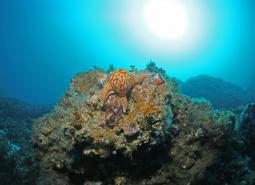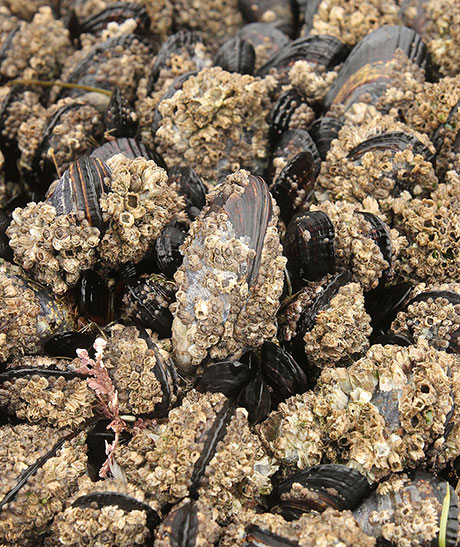
California mussels are large (10 to 15 cm) blue-shelled bivalves that occur in expansive aggregations or clusters in the upper intertidal zone of rocky areas located along the open coast (although some mussels inhabit subtidal areas down to a depth of 24 m). Individual mussels are typically attached to rocks and each other with resilient and elastic byssal threads, and aggregations are frequently exposed to strong surf that periodically rips away patches of mussels. Beds of California mussels are considered to be ecologically important ecosystem engineers that provide heterogeneous biogenic habitat that supports diverse communities of invertebrates and algae. Living mussels are preyed upon by shorebirds, sea stars, snails, crab and other invertebrates. Adult mussels are broadcast spawners that release their gametes freely into the sea, and their long-lived planktotrophic veliger larvae drift and disperse in the ocean for up to a month before they settle along the shore and attach themselves to other mussels and rock. Spatial differences in recruitment and growth are likely driven by large scale oceanographic drivers such as upwelling and nearshore ocean currents that affect larval transport and food availability. California mussels were historically an important source of food for Native Americans and archeological evidence shows that mussels were harvested continuously along the west coast for almost 12,000 years prior to European contact. California mussels are currently the target for nominal recreational and commercial fisheries in Oregon, and they are routinely tested for marine biotoxins which can cause paralytic shellfish poisoning. The biogeographic range extends from the Aleutian Islands (AK) to Baja California (MX).
Overview
- Species Common Name California mussel
- Species Scientific Name Mytilus californianus