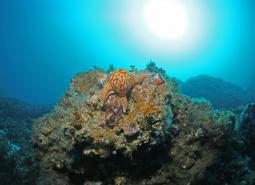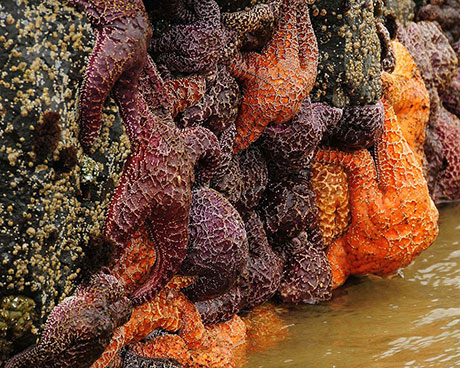
Ochre sea stars are common inhabitants of rocky shelfs, surge channels, cliffs, platforms, tidepools, and other wave-exposed areas along Oregon’s rocky shores. Adults typically have five stout rays that range from 10 to 25 cm in length and individuals can be purple, orange, yellow, reddish, or brown in color. The oral surface of the sea stars rays are equipped with tube-feet that allow them to attach to the rocky substrate or mussels and resist dislodgement by waves and surf. Large numbers of ochre sea stars frequently occur on mussel beds in the intertidal zone on wave-washed rocky shores, and they also occur in subtidal habitats down to a depth of 90 m. They are considered to be an ecologically important keystone species that exerts significant control over the species composition, abundance, and population dynamics of invertebrate communities in rocky intertidal areas. In addition to predation upon beds of mussels (Mytilus californianus), they also feed on chitons, limpets, snails, barnacles, echinoids and crab. Adults are broadcast spawners that release their gametes directly into the seawater, and their planktotrophic bipinnaria and brachiolaria larvae can remain in the water column and disperse in ocean currents for periods from 2.5 to 8 months. Sea gulls are the primary predators of ochre sea stars in Oregon, and sea otters are known to eat the sea stars (and extract their gonads) along the coasts of Washington and California. Populations of ochre sea star (and many other species of asteroids) were decimated throughout their range by Sea Star Wasting Syndrome (SSWS), which is a contagious condition that results in body lesions, tissue decay, rapid disintegration, and death. Sea stars along much of the North American Pacific Coast experienced massive mortality from 2013 to 2015 due to SSWS, and the die-off has persisted at low levels up to the present. Despite the persistence of SSWS, ochre sea stars have largely recovered along the Oregon coast where they sometimes reach densities observed prior to SSWS. The biogeographic range extends from Prince William Sound (AK) to Santa Barbara (CA).
Overview
- Species Common Name Ochre sea star
- Species Scientific Name Pisaster ochraceus