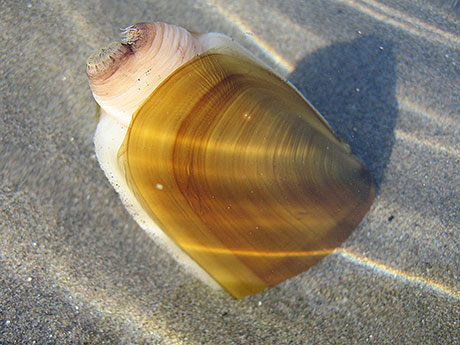
Pacific razor clams are large (8 to 17 cm), fast digging clams that inhabit some of the stable, sandy surf-swept beaches along the Oregon coast. This species has an elongated, narrow shell with a periostracum that varies from light brown in the young small clams, to yellowish and olive-brown in medium-size clams, and darker brown in larger older clams. In Oregon, Pacific razor clams are typically found in the lower intertidal zone and surf zone along sandy beaches that are wide and relatively flat such that they effectively dissipate energy from surf and waves. However, razor clams have also been observed in the subtidal sandy areas out to a depth of 55 m. As filter-feeders, razor clams extend their necks (fused siphons) into the water above the sand and draw in seawater that contains detritus and microscopic algae for food. Mature Pacific razor clams spawn their gametes directly into the seawater, and a large female clam may release up to 100 million eggs during a single spawning event. Embryos and larvae develop in the plankton where they can drift in ocean currents for a period of 5 to 16 weeks. Pacific razor clams are preyed upon by starry flounder, sturgeon, Dungeness crab, seagulls, black bears, and humans. The vast majority of razor clam harvests in Oregon occur along the 18 mile stretch of Clatsop Beach located along the northern coast. However, small populations of razor clams also occur along several other beaches (Cannon Beach, Tillamook Spit, Agate Beach, North Jetty, South Beach, Bastendorff Beach, Bailey Beach). The phytoplankton communities consumed by razor clams frequently include diatoms and dinoflagellates that can produce marine biotoxins which pose a risk for seafood safety, and razor clam tissues are routinely tested for biotoxins. The biogeographic range extends from the Bering Sea (AK) to Pismo Beach (CA).
Overview
- Species Common Name Razor clam
- Species Scientific Name Siliqua patula