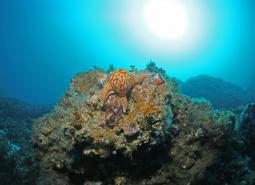
Red abalone are large marine snails (maximum shell length 31 cm, the largest abalone in the world) with a heavy domed-shaped oval shell, a black epipodium, and a yellow-white underside of the broad foot. The external surface of red abalone shells is typically dull brick-red and may be covered by barnacles, sponges, or other epifouling marine organisms, and they have 3 to 4 raised oval holes which are respiratory pores. In contrast, the interior surface of red abalone shells is strongly iridescent with undulating bands of turquoise, greenish-blue, and pink. They inhabit rocky shores that also support kelp, where they live on or under rocks and in deep crevices, and their depth range extends from the low intertidal zone into subtidal areas to a depth of 180 m (although most individuals occur in shallow subtidal areas between 6 to 40 m). Adults consume kelp and understory seaweeds, and also subsist on capture of drift algae, while juveniles graze upon corralling algae and diatom films. Red abalone have separate sexes and they broadcast their gametes freely into the surrounding seawater when they spawn. Fecundity increases proportional to body size, and a small female can release 2,400 eggs per year while a larger female may release 3 to 4 million eggs per year. Fertilized eggs develop into embryos and free-swimming lecithotrophic veliger larvae that remain in the water column for about 1 to 3 weeks. Rock crabs, octopi, cabezon, other bottom-feeding fish, multiple species of sea stars, and sea otters are all known to prey upon red abalone. Red abalone were the targets of a commercial fishery in Oregon for a short time (1958 to 1962), and the recreational fishery was active over the 1950’s to 2021 and suspended indefinitely in 2023. Recent shifts in nearshore ocean conditions and declines in the abundance of kelp over the past decade have contributed to the reduction of red abalone along Oregon’s rocky shores. New analysis of genetic signatures among red abalone from Oregon and California showed little localized variability and suggests that the West Coast population functions as a broad-scale metapopulation with considerable connectivity among different geographic locations. The biogeographic range is typically reported to extend from Coos Bay (OR) to Baja California (MX), although a few individuals have been reported from Depoe Bay, OR and Vancouver Island (BC).
Overview
- Species Common Name Red abalone
- Species Scientific Name Haliotis rufescens