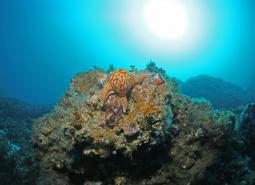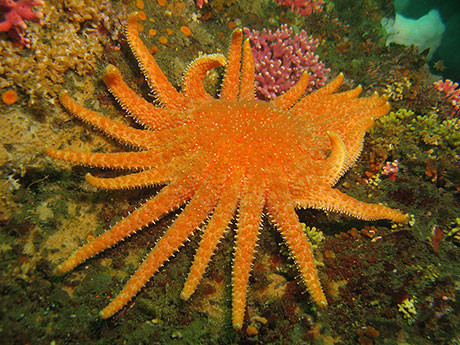
Sunflower stars are among the largest sea stars in the world, with a typical ray length of about 40 cm and a maximum arm span (diameter) of about 80 to 100 cm. Adults are radially symmetrical and usually have 16 to 24 rays (arms) and a soft loose body that can vary in color from purple or reddish-orange, to yellow, violet brown, or slate-blue. They generally inhabit low intertidal and subtidal areas down to a depth of 435 m, although most individuals occur at depths less than 120 m. Sunflower stars occupy a diversity of habitats, including tidepools and rocky beaches, as well as eelgrass beds, mud, sand, gravel, boulders, and bedrock. They are predatory, carnivorous, and feed upon a variety of prey items, including sea urchins, sand dollars, sea cucumbers, other sea stars, crab, barnacles, clams, mussels, abalone, snails, chitons, dead or dying squid, fishes, sponges, and other small invertebrates. Adults are broadcast spawners that release their gametes directly into the seawater, and their planktotrophic bipinnaria and brachiolaria larvae can remain in the water column and disperse in ocean currents for periods from 2 to 10 weeks. Juveniles begin life on the benthos with 5 rays, and they grow additional rays as they mature. The lifespan of most sunflower stars is estimated at 3 to 5 years, and during that period they are preyed upon by sea gulls, fish, crab, and other sea stars. They are considered to be ecosystem engineers that regulate the structure of benthic subtidal communities, primarily through predation upon sea urchins. Populations of sunflower stars (and many other species of asteroids) were decimated throughout their range by Sea Star Wasting Syndrome (SSWS) which is a contagious condition that results in body lesions, tissue decay, rapid disintegration, and death. Sea stars along much of the North American Pacific Coast experienced massive mortality from 2013 to 2015 due to SSWS, and the die-off has persisted at low levels up to the present. Sunflower star largely disappeared from its normal habitats in marine waters off the coast of Oregon from 2016 to 2020, however numerous small juveniles have been observed in intertidal and shallow subtidal areas over 2023 to 2025. The biogeographic range extends from the Aleutian Islands (AK) to San Diego (CA).
Overview
- Species Common Name Sunflower star
- Species Scientific Name Pycnopodia helianthoides