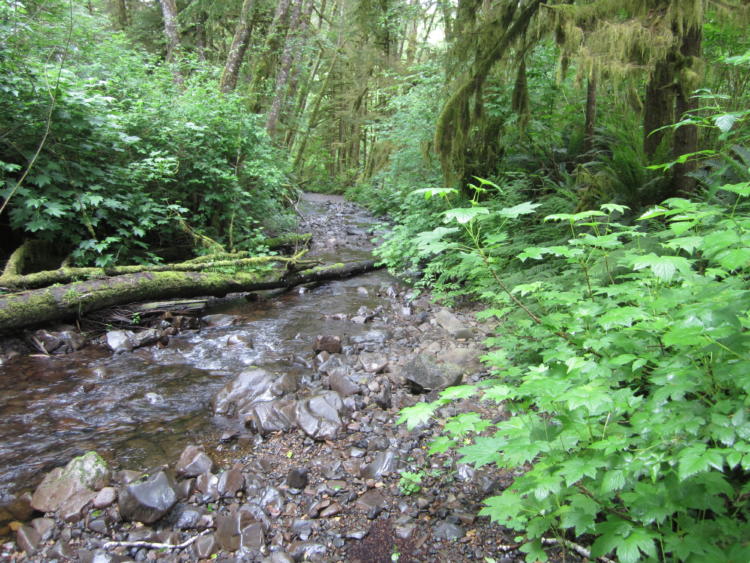
Flowing Water and Riparian Habitats include all naturally occurring flowing freshwater streams and rivers throughout Oregon as well as the adjacent riparian habitat.
Limiting Factors and Recommended Approaches
Limiting Factor: Water Quantity
Multiple factors are affecting the amount of water in Flowing Water Habitats. Water diversions for out-of-stream uses occur on all major streams, and valley bottoms often have multiple canals that divert water away from the natural channel. Water availability is limited in much of the state, especially during the low flow summer and fall months. Low flows are associated with higher water temperatures and higher nutrient and contaminant concentrations in creeks, streams, and rivers. As a result, the instream needs of fish and wildlife are largely not being met. Out-of-stream needs are expected to increase with population growth and under a changing climate, further competing with instream flow available for fish and wildlife habitat. Riparian bottomland habitats also compete for water with other uses, particularly in the Blue Mountains, Columbia Plateau, East Cascades, Klamath Mountain, and Northern Basin and Range ecoregions.
Recommended Approach
Conduct instream flow studies to develop ecological flow targets and apply for associated instream water rights to legally protect instream flow. Engage with regulatory agencies to ensure consideration of fish and wildlife needs in water right and hydropower processes. Identify priority locations for voluntary instream transfers and leases. Implement water conservation actions to protect or increase instream flows (quantity, timing, and duration) following the natural hydrological cycle. Increase pace and scale of voluntary flow restoration through instream leases, transfers, and irrigation efficiency improvements. Manage beaver populations to contribute to water storage and availability, when compatible with existing land uses. Pursue collaborative water planning and implementation processes to secure balanced solutions for water management. Provide incentives and information about water conservation and sharing at key times of low flow conditions (e.g., late summer).
Limiting Factor: Invasive Aquatic Species
Alterations in hydrology can make flowing water habitat more susceptible to invasive plants, invertebrates, and fish. Invasive fish species (e.g. bass, crappie, bluegill, yellow perch, bullhead, carp, brook trout, fat head minnow, non-native ringed crayfish) can compete with native fish and amphibians for food resources and habitat, prey on native species, alter habitat, or hybridize with native fish. For example, non-native carp can overgraze aquatic vegetation and stir up sediment, depriving native fish and amphibians of egg-laying sites or preventing eggs from absorbing enough oxygen to develop. Invasive mollusks (e.g. zebra mussel, quagga mussels) can disrupt food chains by reducing the availability of food for larval and juvenile fishes. They also attach easily to boats, docks and buoys and can clog intake pipes as well as drains. Invasive plants (e.g. Ludwigia spp., watermilfoil, parrot feather, hydrilla) can reduce light penetration, lower species diversity, alter temperature, reduce dissolved oxygen and pH, and disrupt nutrient cycling, leading to algae blooms and toxicity.
Recommended Approach
Work with community partners to restore and maintain natural hydrologic regimes to ensure habitat conditions best support native fish and wildlife. Continue working with the public to stress the importance of preventative measures for excluding and detecting quagga and zebra mussels from Oregon waterways. Where appropriate, work to minimize predation on sensitive native species. Where non-native aquatic species threaten SGCN, consider site-appropriate tools (e.g., mechanical or chemical treatment) in locations and during seasons where they will not harm native amphibians, fish, or invertebrates. Educate and inform people about the problems that can be caused by invasive species, including the harm of releasing aquarium fish or nonnative fish into our rivers, dumping non-native aquarium plants in waterbodies, and the importance of having boats cleaned before moving to a different waterbody.
Limiting Factor: Passage Barriers and Channel Complexity
Channel complexity is important for fish and wildlife, and they depend on natural flow regimes and substrates for breeding, foraging, cover, and migration. For example, woody debris and other natural structures provide nutrient cycling and refugia from predators and high temperatures. Dams, road culverts, or other human-made barriers can restrict movement of fish and wildlife, alter instream flow, and restrict bedload movement and the fluvial processes necessary to create the types of riparian and stream habitats to which native species are adapted. Large dams disrupt natural hydrologic regimes, which decreases the amount of bottomland habitat and impacts anadromous and other migratory fish passage upstream and downstream. Additionally, altered flow regimes can contribute to unnatural temperature regimes in some streams, making habitat inhospitable.
Misaligned culverts disconnect stream passage corridors, block fish passage, and may force wildlife to cross over roads where they are vulnerable to vehicles and predators. Undersized or improperly sized culverts can alter the transport of sediment and wood, creating an uneven distribution of instream habitat.
Recommended Approach
Work with landowners and regulatory agencies to protect and restore natural flow and channel conditions on streams impacted by barriers. Eliminate passage barriers or improve passage at existing barriers to provide travel corridors for fish and wildlife. Design future projects with appropriately sized culverts to accommodate adaptation to modeled hydrologic regimes with climate change. Replace culverts or other passage barriers with structures that mimic natural conditions as closely as possible (e.g., bridges or open-bottom arch culverts). Provide additional passage structures for fish and wildlife at culverts. Provide sufficient channel complexity to maintain ecological benefits for fish and wildlife.
Limiting Factor: Pollution
Point and non-point source pollution are of concern in both rural and urban areas. Point source pollution from industrial, domestic, and stormwater treatment may contain high levels of contaminants. Non-point source pollution in flowing waters and adjacent floodplains can contain fertilizers, pesticides, or oil-based pollutants at levels high enough to cause significant lethal or sub-lethal effects in native fish and wildlife. Agricultural runoff and high concentrations of livestock in or near streams can degrade water quality through excessive nutrient and bacteria inputs. Agricultural runoff may also carries pesticides from treated fields into flowing waterways. High nutrient concentrations in streams can cause anoxic conditions, excessive aquatic vegetation, and harmful algae blooms. Pesticides in flowing waterways have the potential to damage all forms of aquatic life and may accumulate in the tissue of fish and waterfowl consumed by other wildlife and humans.
Recommended Approach
Increase awareness of the impacts of urban and rural runoff. Treat stormwater runoff that flows directly into streams to address tire-wear particles and their associated contaminants (e.g. 6PPD-q), an emerging concern in the Pacific Northwest. Reduce stormwater runoff and increase permeability in urban areas with bioswales. Use stormwater catchment basins designed for larger volume, longer residence, and a high degree of shading to mimic the delay, treatment, infiltration, and cooling functions of natural wetlands. Reduce sewage overflows during major rain events where raw sewage is discharged directly into streams. Increase awareness and manage timing of pesticide applications that have the potential to harm aquatic communities. Improve compliance with water quality standards and pesticide use labels administered by the DEQ and U.S. Environmental Protection Agency (EPA). Reduce water pollution from agricultural sources and improve watershed conditions throughout the state through implementation of ODA rules and DEQ Total Maximum Daily Load water quality plans. Establish riparian buffer zones along streams adjacent to livestock feeding operations and farmland. Improve efficiency of irrigation systems to reduce agricultural runoff and increase instream flow. Increase interaction between rivers and floodplains. Encourage opportunities for restoration of wetlands and channel meanders to increase water storage. During restoration, restore stream channels to promote flow, nutrient, and oxygen exchange. Where possible, provide sufficient room to restore meanders and other stream functions.
Limiting Factor: Water Temperature
High water temperatures, particularly summer stream temperatures, are a major threat to self-sustaining populations of native species and can severely limit population viability for Oregon’s native anadromous and cold-water species. Aquatic animals have specific requirements for a tolerable temperature range. Moreover, warmer water holds less dissolved oxygen, resulting in hypoxic conditions, especially during seasonal low flows. Hypoxia, which refers to low or depleted oxygen in a water body, may be lethal to organisms that extract oxygen from water, such as fish and amphibians. Water temperature may become too warm for native aquatic life because of alterations in stream flow, thermal pollution, or reduced riparian shading, especially during seasonal low flows. This threat to native species is likely to increase with predicted regional climate change effects that include prolonged droughts, higher air temperatures, lower snowpack, and shifts in timing of rainfall and snowmelt.
Recommended Approach
Assess riparian habitat conditions and implement planting projects to increase native riparian habitat cover and promote shade, which can limit thermal maxima in summer months. Maintain and restore in-stream flow to help preserve favorable water temperatures. Advance real-time water temperature monitoring and forecasting techniques and conduct monitoring in priority areas. Identify and protect cold-water resources and refugia. Minimize release of unnaturally warm water from dams and reservoirs when instream temperatures are high by altering intake/release structures and management.
Limiting Factor: Sedimentation
Sediment flows into streams from natural processes; however, it is exacerbated through human activities. Deposition of fine sediment in gravel-bottom rivers and streams fills the interstices of the gravel, reduces the velocity of water flow through the gravel, and decreases the dissolved oxygen content. An excess of fine sediments can cover eggs of native fish and amphibians, reduce cover and protection from predators, and create adverse physical conditions. Salmonids such as salmon and trout rely on clean gravel to build redds. When fine sediment fills the spaces between gravel it prevents water from flowing through redds and oxygenating trout and salmon eggs, which reduces egg survival. In more severe cases, sediment fills the spaces between gravel and can harden the streambed rendering it unusable to spawning salmonids. Sediment can also bury freshwater mussels and other aquatic mollusks. Aquatic insects rely on interstitial spaces between boulders, cobble, and gravel and many feed on periphyton that grows on these hard substrates. When sediment fills the spaces between large substrate or covers it completely, this habitat is lost, and streams can no longer support the invertebrate communities that feed fish and other wildlife.
Recommended Approach
Reduce run-off of fine sediment from logging, agriculture, grazing, roads, and other activities that could disturb soil or destabilize streambanks. Implement strategies and best management practices to reduce sedimentation including filtering run-off before it enters aquatic systems, decommissioning roads, installing green infrastructure, terracing fields, installing sediment control basins to reduce erosion, planting cover crops, and practicing conservation tillage. When constructing new roads, consider sediment removal capabilities in road design. Maintain and restore native riparian and wetland vegetation to filter sediments. Utilize large wood instream to improve stream channel complexity by increasing sediment retention and sorting, creating gravel bottom habitat, and promoting the formation of pool habitat.
Limiting Factor: Loss of Riparian Habitat, Floodplain Function, and Habitat Complexity
A large percentage of Oregon’s low-elevation and valley bottom riparian habitats have been altered or lost. Riparian habitat is often cleared, diked and converted into developed land, including urban areas, agricultural fields, or grazing pastures. Extensive removal of riparian habitat can lead to altered hydrological regimes, warmer water temperatures, erosion promoting downcutting or widening of stream banks, and loss of habitat complexity as floodplains and side channels become disconnected from streams. This loss of floodplain connectivity is a key limiting factor for nearly all listed anadromous fish species and many wildlife species. In addition, the increases in stream temperatures as a result of depleted riparian habitat often provide ideal habitat for non-native species (e.g., game fish such as bass), allowing the non-native species to thrive and outcompete native cold-water salmon and steelhead. Development within historical floodplains can restrict the natural ability of streams and riparian habitats to meander, limiting the creation and maintenance of new aquatic and riparian habitats. Lack of channel forming and flushing flows resulting from flood control efforts have also reduced floodplain processes, habitat creation, and habitat complexity. Developed floodplains are less effective in storing water and slowly releasing it back into the streams, filtering sediment and pollutants from surface water, and providing habitat for fish and wildlife. Losses of riparian habitat complexity and connectivity limit the value of these important places for wildlife to meet crucial life history needs.
Recommended Approach
Enhance or restore the extent and connectivity of existing riparian habitats. Promote lateral connectivity of the floodplain to off and side channel habitat. Use voluntary cooperative efforts and incentive programs (e.g., Conservation Reserve Enhancement Program, Riparian Lands Tax Incentive Program) to conserve, maintain, and restore riparian habitats on private lands. Identify and apply lessons learned from successful riparian restoration efforts on private lands to guide future projects. Develop tools and financial incentives to assist landowners with erosion prevention, as well as riparian area and streambank management best management practices. Provide outreach and education on the functions of riparian habitat and best management practices for landowners, including coordination with local governments on implementing Goal 5 protections and ODA for Agricultural Water Quality Management Area Plans.
Maintain and restore riparian buffers and minimize impacts from development actions. Close and revegetate unused roads on public lands. Support and encourage beaver occupancy and their canal and dam building activities, where possible, to restore floodplain-riparian processes and function when compatible with existing land uses. Maintain channel integrity and natural hydrology. Ensure that adequate native riparian vegetation remains following management activities to prevent erosion, preserve water quality, and maintain water temperatures favorable for aquatic life. Restore lost vegetation through planting of native trees, shrubs, and ground cover, and manage for future sources of large woody debris. Maintain and/or expand existing tracts of large trees, such as cottonwoods, to benefit riparian habitat function.
Limiting Factor: Riparian Habitat Degradation
In the Blue Mountains, Northern Basin and Range, East Cascades, and Columbia Plateau ecoregions, historical overgrazing has led to soil erosion, poor regeneration of hardwood trees and shrubs, changes in plant species composition and structure, and degradation by invasive plants. Although some areas are slowly recovering, many miles of stream are still lacking adequate riparian vegetation. Ongoing grazing impacts remain in some areas, especially at low and mid elevations. Western juniper is encroaching in some riparian areas of eastern Oregon.
Recommended Approach
In cooperation with landowners, land managers, and grazing lessees, encourage approaches such as off-site watering or active management that keep livestock out of riparian areas. Develop and implement grazing regimes that are compatible with riparian conservation objectives. Selectively fence restoration sites or other high priority areas to exclude ungulates. Evaluate impacts by encroaching western juniper and remove juniper from upper reaches of higher elevation watersheds, if appropriate. Plant riparian vegetation using native species at priority sites. Work with landowners and grazing permittees to support riparian conservation and land management objectives.
Limiting Factor: Invasive Plants in Riparian Habitat
Invasive plants, such as knapweeds, knotweeds, reed canary grass, Himalayan blackberry, thistles, poison hemlock, and teasels, degrade riparian habitats by competing with and replacing native plants. In the Columbia Plateau and Northern Basin and Range ecoregions, pasture grasses and cheatgrass commonly dominate the understory. Invasive plants can alter the structure of riparian habitats, creating dense monocultures that hinder the growth of native vegetation and changing the physical structure of the streambank. They often provide insufficient food and habitat resources, displacing fish and wildlife and reducing biodiversity.
Recommended Approach
Control key invasive plants using site-appropriate tools, including fire and mechanical, biological, and chemical treatments. Use chemical treatments carefully and where compatible with water quality concerns, focusing on spot treatment during the dry season. Partner with Soil and Water Conservation Districts or other experts to control invasive weeds and restore riparian habitats. In the Columbia Plateau and Northern Basin and Range ecoregions, focus control at low-elevation sites. Provide information to local governments and landowners about potential invasive plants. Where necessary, develop and implement grazing management regimes that are compatible with riparian conservation objectives. Replace invasive plants with local native species so there is no net loss of wildlife habitat in the long term.