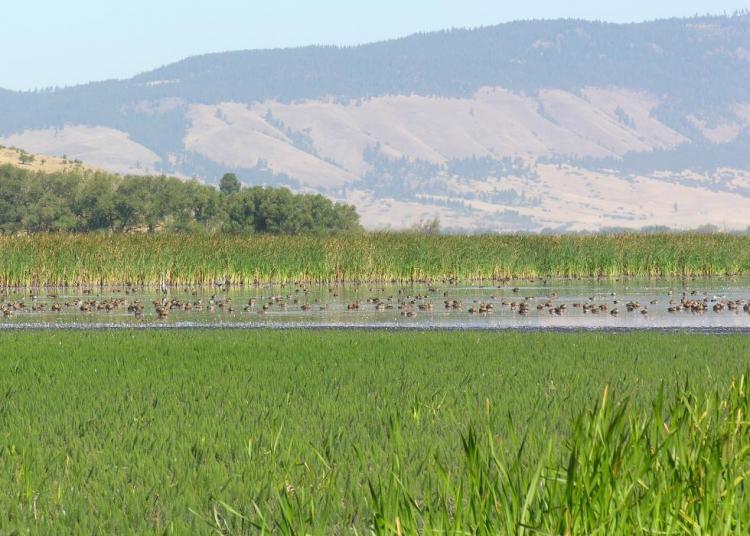
Wetlands are habitats that are inundated or saturated by surface water or ground water at a frequency and duration sufficient to support vegetation typically adapted for life in sodden soil conditions. While dominated by periods of inundation, the natural ecological cycle may also include dry intervals. Permanently wet habitats include backwater sloughs, oxbow lakes, peatlands, and marshes, while periodically wet habitats include seasonal ponds, vernal pools, and wet prairies. The Oregon Department of State Lands identifies many wetland habitats as Aquatic Resources of Special Concern, such as wet prairies, bogs, fens, interdunal, forested and alkaline wetlands, which provide functions, values and habitats that are limited in quantity because they are naturally rare or have been disproportionately lost due to prior impacts.
Ecoregional Characteristics
Blue Mountains
In the Grand Ronde and Baker Valleys, much of the lower elevation wetlands have been drained and converted to agriculture. Most remaining wetlands in this ecoregion are found in high-altitude basins and depressions, although some important valley bottom wetlands occur along rivers and streams, in floodplains, and in basins and depressions that collect runoff or groundwater. Ladd Marsh Wildlife Area offers an example of the importance of intact wetland habitat for wetland dependent species.
Coast Range
Salt marsh habitats provide vital stopover points for migratory birds and support a diversity of marine species. Wetlands in this ecoregion are vulnerable to development, especially as coastal populations grow. The ecological processes that create coastal wetlands, such as landslides, beaver activity, or logjams blocking streams, often are not compatible with current land uses, especially in more developed areas. Early planning that allows for appropriate riparian buffers along coastal rivers and streams can maintain many important wetland and stream functions, including flood control, water retention and storage, shading, and decreased contaminant inputs. Many of these functions will help to maintain higher stream flows and lower water temperatures in months with less precipitation. The Coast Range ecoregion is also home to Darlingtonia State Park where a serpentine wetland has a population of rare Darlingtonia (pitcher pants). This park demonstrates the variety of wetland habitats and the plants that inhabit them.
Columbia Plateau
Historical wetlands along the Columbia River have been inundated by reservoirs, while floodplain wetlands along the Umatilla and Walla Walla rivers and other tributary streams have mostly been developed for agriculture. This ecoregion once had extensive springs and vernal pools, many of which have been lost as water tables lowered. Currently, many wetlands in this ecoregion are man-made, such as marshes established along the edges of reservoirs and wetlands created as a result of crop irrigation practices. The Wanaket Wildlife Area, managed by the Confederated Tribes of the Umatilla, is a network of wetlands created through irrigation of pastureland that provides important habitat for many wetland-dependent species. Similarly, ponds on the Umatilla National Wildlife Refuge use runoff from the fish hatchery to support seasonally wet shallow pools for migrating shorebirds and to provide breeding habitat for amphibians. Irrigation wetlands in this ecoregion can provide important habitat but can also be adversely impacted by runoff containing fertilizers or other chemicals.
East Cascades
The upper Klamath Basin once had an extensive shallow lake and marsh system, but much of that system has been lost due to drainage and conversion to agriculture and urban uses. These changes have contributed to the complex issues surrounding water use and species conservation in the basin. The remaining wetlands in the Klamath Basin support one of the largest concentrations of waterfowl in North America, with millions of ducks, geese, and other waterfowl migrating through the basin annually. In the winter, the Klamath Basin hosts the largest assemblage of wintering Bald Eagles in the continental United States. The Klamath Basin provides Oregon’s only permanent nesting areas for Red-necked Grebes and most of the nesting areas for Yellow Rails. High quality wetland habitats are also found in the Upper Deschutes River Basin.
Klamath Mountains
Most low-elevation, seasonal wetlands have been lost due to conversion to agriculture, urban and rural residential uses, energy development, and transportation systems. Altered hydrology and upland activities like groundwater withdrawal impact many remaining wetland habitats. High elevation wetlands are severely impacted by livestock grazing. Scarce vernal pool wetlands in the Agate Desert near Medford support several rare plant and animal species. These vernal pool wetlands are formed in areas with unusual topography and soil layering and are very difficult to replace when ground is leveled for development.
Northern Basin and Range
The Northern Basin and Range ecoregion contains several large, deep freshwater marshes. Significant wetlands are associated with the large lake basins, including Lake Abert, Summer, Malheur, and Harney Lakes, and the Warner Basin. However, many of the ecoregion’s smaller historical wetlands have been lost due to conversion or degradation from stream channelization, water use, water diversions, and historical overgrazing. Creation of watering holes for livestock and wildlife has altered the hydrology at many major alkaline wetlands, making them one of the most altered habitat types in the ecoregion.
In some areas, flood-irrigation of private pasture and hay meadows provides important seasonal habitat for migrating and breeding birds. Nevertheless, flood irrigation can negatively impact water quality, increase sedimentation, and increase water loss due to evaporation. Cooperative projects, such as settling ponds designed for cleaning flood irrigation “tail water”, or conversion to piped sprinkler systems may offer a way to address water quality issues.
West Cascades
Wetlands in this ecoregion are generally in good condition, although some areas, such as those located around Mt. Hood and Mt. Jefferson, can be impacted by uncontrolled livestock grazing, camping, or off-highway vehicle use. Climate change projections estimate that wetland hydrology in the West Cascades could be impacted by shifts in rainfall and snowmelt and increasing temperatures.
Willamette Valley
Almost all remaining wetlands in this ecoregion have been degraded to some degree by altered water regimes, pollution, and invasive plants and animals. The Willamette Valley ecoregion also used to have extensive networks of off-channel habitat, deciduous swamps and shrublands, marshes, seasonal ponds, and vernal pools. However, most of these habitats have been lost to agriculture and urbanization.
Wetlands in the Willamette Valley serve important ecological functions for communities, provide habitat for amphibians, reptiles, birds, and fish, and offer key bird and fish migratory pathways. Once an abundant ecosystem within the Willamette Valley, native wetland prairies have declined dramatically in extent since the mid-1800s due to a variety of factors including a growing human population, agricultural conversion, urbanization, drainage, and colonization by invasive and woody vegetation. In particular, wetland prairie habitat is regarded as one of the most imperiled in the Willamette Valley ecoregion.
Limiting Factors and Recommended Approaches
Limiting Factor: Habitat Loss
A high percentage of low-elevation and valley bottom wetlands have been lost or degraded through diking and draining, particularly in the Klamath Mountains and Coast Range ecoregions. In other areas, overgrazing has led to soil compaction, changes in plant species composition, and spread of invasive plants. Due to short growing seasons and other factors, degraded wet meadows can be slow to recover if overgrazed. Saltmarshes have experienced substantial losses over historical condition from diking, installation of tide gates, draining, and filling of tidally influenced marshes. Wetlands provide vital habitat for migrating shorebirds and waterfowl. Loss or degradation of wetland habitat in the Pacific Flyway could potentially have large impacts on bird populations while early season haying in wetland habitats can result in poor reproduction of ground-nesting birds due to destruction of nests and direct mortality of young.
Many wetlands are lost through urbanization, which involves filling or draining the wetland for development. Unfortunately, this removes wetlands from locations where the functions they provide might have the most value for SGCN. Maintaining wetland and adjacent habitats provides social benefits, such as storage of flood water and treatment of contaminants before reaching streams and ground water.
Recommended Approach
Protect and conserve priority wetland habitat that provides vital breeding habitat for SGCN and stopover sites for migrating species (KCI: Barriers to Animal Movement). Identify wetlands that have been altered or lost and determine their potential for restoration. Build upon current cooperative efforts to maintain and restore wetlands in partnership with private and public landowners. Cooperative voluntary approaches are important for wetland conservation on private lands. Continue to provide incentives to protect, maintain, or restore wetlands, such as the Wetland Reserve Enhancement Partnership (WREP) offered through the Natural Resources Conservation Service and private mitigation banking. Prioritizing development of wetland mitigation banks to support SGCN also provides a strategic landscape approach to addressing wetland loss.
Develop and implement grazing regimes that are compatible with wet meadow conservation objectives. Use cooperative efforts and incentive programs to establish semi-permanent livestock exclusion zones in priority areas. In partnership with landowners, implement later haying dates in critical bird nesting areas (see The Willamette Valley Landowner’s Guide to Creating Habitat for Grassland Birds). Manage beaver populations to contribute to wetland creation and maintenance, when compatible with existing land uses.
Promote outreach and education programs to educate individuals, communities, city and county planners, agricultural groups, and forest industries about the function and services provided by wetlands. Work with the local planning process and the Oregon Department of State Lands to promote the value of maintaining wetlands and habitat corridors, especially along floodways, where they can best function to protect structures, infrastructure, and water quality.
Limiting Factor: Drought
Drought affects the quality and extent of wetlands across the state. Drought has resulted in less precipitation, interception, infiltration, and percolation of water into the soil, falling water tables, increased evaporation, decreased transpiration, decreased plant and animal diversity and distribution, and the acidification, cracking, and compaction of wetland soils. These changes in hydrology and soils affect plant and animal diversity, connectivity with other aquatic resources and upland habitats, the proportion of invasive plant species in the wetland, and wetland functions. Climate change patterns are expected to exacerbate and or extend drought periods resulting in wetland loss of acreage and functional changes.
Recommended Approach
Educate the public and water users to conserve water. Look for opportunities to restore and enhance wetlands (i.e. Barnes and Agency Wetland Restoration- Upper Klamath National Wildlife Refuge), reuse water for multi-benefit solutions, and improve wetland habitat through water use efficiencies (i.e. Lower Klamath and Tule Lake National Wildlife Refuges). Coordinate with ODFW Fish Passage and District Fish Biologist staff on appropriate approvals for instream, beaver-mimicry (e.g., beaver dam analogs, small and/or large wood structures) and/or coexistence (e.g., pond levelers, culvert exclusion devices) structures to raise the water table, restore wetland and waterway connections, and improve habitat conditions (i.e. Sprague Watershed).
Limiting Factor: Water Quantity
Water is extremely limited in much of the Blue Mountains, East Cascades, and Northern Basin and Range ecoregions. As a result of limited water availability, there is competition for water resources, particularly in late summer. Lowered water tables affect wetland habitats. Competition for water harms both ecological and economic goals. Water diversions for other uses change the seasonality of flooding, slow habitat recovery, and increase invasion of non-native grasses. Drought years intensify water shortages.
Recommended Approach
Use cooperative efforts and incentive programs, such as financial incentives, for wetland restoration, water right acquisition, and wetland mitigation banking, to enhance management of water allocation and improve wetland habitats. Implement water conservation actions, where possible, to increase availability (quantity, timing, and duration).
Limiting Factor: Degraded Water Quality
Although wetlands have a role in purifying water, water quality is poor in some wetland systems. High temperatures affect water quality in some areas. Non-point source runoff from agricultural and residential areas contains pollutants that can affect water quality and nutrient levels, and these levels may increase as water evaporates throughout the season. High nutrient loads can contribute to toxic algal blooms.
Recommended Approach
Provide incentives to decrease and manage the release of potential contaminants, such as fertilizers or pesticides, by controlling the timing of application. Use incentives to promote substitutes that are less toxic to wildlife and break down quickly in the environment. Promote the creation of stormwater treatment projects, fencing of aquatic habitats to exclude livestock, and restoration of riparian buffers and additional wetlands to increase filtering capacity. Support irrigation systems that conserve, re-collect, and re-use water more effectively, use gray water, and provide shaded treatment areas that can provide cooling and habitat. In the Willamette Valley, adopt critical actions recommended by the Willamette Restoration Initiative on Clean Water, such as: reduce the levels of toxins and other pollutants in the Willamette Basin, provide incentives to decrease water pollution, and promote education and outreach programs for landowners.
Limiting Factor: Invasive Species
Invasive species, such as reed canary grass, purple loosestrife, Ludwigia spp. and Japanese knotweed, invade and degrade wetlands, thereby displacing native plants, reducing plant community diversity, reducing sources of food for wildlife, and altering water flow and storage function. Invasions of non-native grasses, such as reed canary grass, can also create conditions more prone to wildfires.
Invasive, non-native carp can impact wetlands by consuming important plants and by increasing turbidity, disturbing sediments, and altering biological dynamics for sediment-associated plants and animals. Turbidity also contributes to higher water temperatures and lower levels of dissolved oxygen. Non-native bullfrogs have had a devastating impact on native amphibians and reptiles, leading to the extirpation of Oregon spotted frog and leopard frogs from much of their historic range. Emerald ash borer is now present in the Willamette Valley and threatens to cause extensive losses to ash trees, which are a critical component of off-channel wetland habitats.
Native trees and shrubs can become invasive due to the exclusion of fire from wetlands. Without fires from natural ignitions and Indigenous peoples cultural burning practices, encroachment by native vegetation can overwhelm wetlands and out compete wetland grasses and flowers by reducing water availability, shading, and changing soil chemistry.
Recommended Approach
Emphasize prevention, risk assessment, early detection, and quick control to prevent new invasive species from becoming fully established. Control key invasive plants using site-appropriate tools, such as flooding (reed canary grass), biological control (purple loosestrife), and mechanical treatment including mowing. Use chemical treatment carefully and where compatible with water quality concerns, focusing on spot treatment during the dry season. Consider screening or adjusting water levels to control carp. Use revegetation and other means to establish and maintain native plant communities that are relatively resistant to invasion and that also meet other land use objectives.