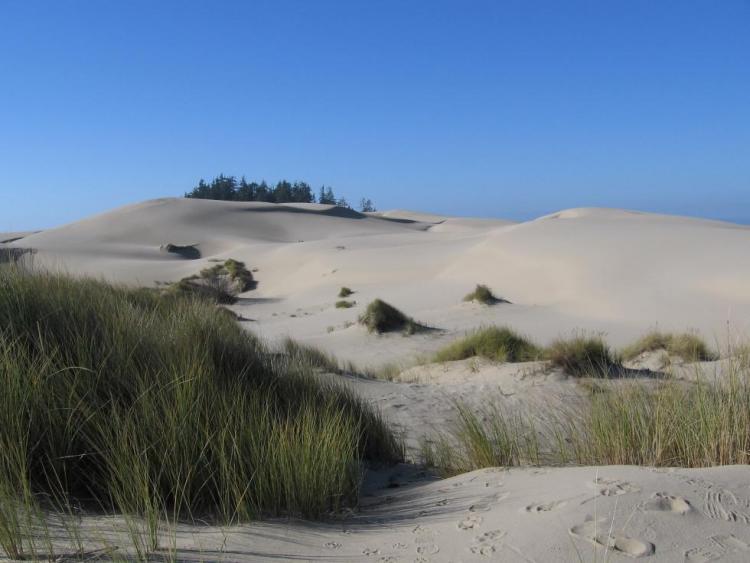
Occurring along the Oregon coastline, coastal dunes provide habitat for species that prefer open, sandy habitats with a high degree of disturbance from winds and tides.
Conservation Overview
Coastal dune communities have been altered dramatically through the introduction and spread of non-native European beachgrasses, which outcompete native vegetation and stabilize foredunes. The stabilized foredunes block movement of sand inland and artificially accelerate plant succession toward shrubland and forest. Dunes artificially stabilized by non-native beachgrasses have contributed to commercial and residential development of sandy habitats that were once naturally active, shifting shoreline ecosystems. In Oregon, almost all coastal dunes have been altered from their natural state since 1850.
Species that live in coastal dune habitats generally prefer open, sandy environments with a high degree of disturbance from winds and tides. Species of Greatest Conservation Need associated with coastal dunes include the Western Snowy Plover, Pacific marten, pink sand verbena, Wolf’s evening primrose, silvery phacelia, and seaside gilia.

Limiting Factors and Recommended Approaches
Limiting Factor: European Beachgrass and other Invasive Plants
European beachgrass stabilizes dunes, resulting in changes in vegetative communities and loss of open sandy habitats that are vital to native species. Stabilized dunes are vulnerable to other invasive non-native species, such as hybrid beachgrasses, Scotch broom, and gorse, which displace native plants and animals and accelerate succession. Encroachment by shore pine and other woody species is also an issue.
Recommended Approach
Use mechanical and chemical treatment to control European beachgrass in priority areas, such as Western Snowy Plover nesting areas and near pink sand verbena populations. Build on existing restoration efforts to control beachgrass. Control key invasive non-native plants using site-appropriate tools, such as mechanical (e.g., mowing, girdling, hand-pulling), chemical, and biological control (for gorse) treatments.
Limiting Factor: Development
Stabilized dunes are targeted for development for residential housing, which leads to habitat loss and increased direct/indirect impacts to wildlife through disturbance.
Recommended Approach
Use voluntary cooperative approaches, such as financial incentives, Candidate Conservation Agreements with Assurances, and conservations easements with private landowners to maintain dune habitats. Work with agency partners to support and implement Statewide Land Use Goal 18, “Beaches and Dunes”.
Limiting Factor: Recreational Impacts
In some areas, recreational use can disturb wildlife habitat (e.g., Western Snowy Plover nesting areas). Off-leash dogs may also disturb habitat and chase or harass wildlife. Off-highway vehicles can also impact vegetation and disturb wildlife.
Recommended Approach
Work with land managers to direct recreational use away from sensitive areas. Close areas to access during sensitive or vulnerable periods. Provide recreational users with information on coastal dune conservation issues and low impact uses.
HABITAT CHANGE TRENDS ANALYSIS
Loss of Coastal Dunes
To investigate loss of coastal dune habitat, the Institute of Natural Resources (INR) compared the total area and spatial overlap of vegetation classes in two baseline maps (1855-1910 and 2016). The analysis showed loss of coastal dune habitat over time. By 2016, the total area of coastal dunes had declined by 24% when compared to historical data. There was also evidence of significant shifts in where open dune habitat is located, with some previously open dunes becoming vegetated and stabilized, and new open sand dunes established where dunes were previously stabilized.