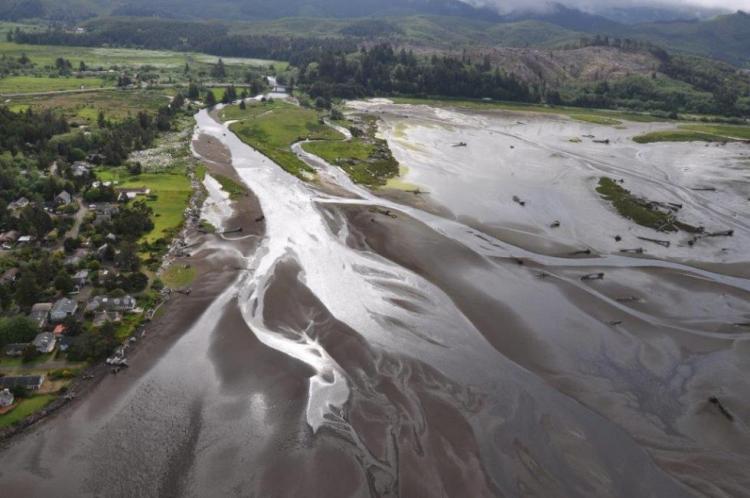
Estuaries are broadly defined as partially enclosed coastal bodies of tidally influenced water with one or more inputs of freshwater, and with a free or intermittent connection to the open sea. Estuaries typically occur at locations where freshwater from rivers, streams, or creeks meets saltwater from the nearshore ocean, creating a tidal basin that experiences frequent flooding and draining and periodic changes in salinity and other water parameters. Freshwater tidal estuaries can also occur in large floodplain rivers, such as the Columbia River, that are strongly influenced by riverine and estuarine hydrology.
Characteristics
Estuaries are characterized by the mixing of fresh and salt water within a semi-enclosed tidal basin, by the flux and dynamics of sediments and nutrients, and by the composition and functions of distinct biological communities. The spatial extent of each Oregon estuary begins on the seaward side where it meets the ocean and extends upstream and inland to where the average difference between tidal water levels is 0.2 ft (0.06 m). In many cases, the estuarine tidal basin encompasses a marine-dominated zone, a mixing zone, and a brackish-to-fresh zone that can extend many miles inland away from the ocean.
Oregon’s statewide framework for management planning within estuaries (Goal 16) seeks to recognize and protect the unique environmental, economic, and social values of each estuary, and where appropriate, develop and restore the long-term environmental, economic and social values, diversity, and benefits. The statewide planning framework classifies estuaries as development (deep or shallow draft), conservation, or natural, which define the prominent use or activities in the estuary and specify allowed locations for various uses (Figure 1). All of Oregon’s estuaries are crucial to the coastal and nearshore ecology and support a diversity of habitats and species.

Photo Credit: ODFW.
Figure 1. Oregon’s major estuaries are classified into four levels for development and planning purposes.
Physical Environment:
Several distinct geomorphic types of estuaries occur on the Oregon coast and along the Columbia River. The geological and hydrodynamic forces that created each estuary differ from place to place, and the physical environment that maintains them varies substantially over space and time. Estuaries have been grouped using a number of different classification schemes that may account for differences in geomorphology, region, or the relative importance of marine and watershed inputs. These classifications include:
River-dominated drowned river mouth estuaries: (i.e., Columbia River, Necanicum, Nehalem, Nestucca, Salmon River, Siletz, Alsea, Siuslaw, Umpqua River, Coquille River, Rogue River, Chetco River) The mouths of these river-dominated estuaries were inundated by rising sea levels, and they are characterized by substantial in-flows of freshwater that drain coastal watersheds. The strong riverine input has a primary influence on the shape of the tidal basin, level of salinity, sediment dynamics, and ecological characteristics of the waters and shoreline habitats, rather than marine forces such as the ebb and flow of daily tides.
Tide-dominated drowned river mouth estuaries: (i.e., Tillamook Bay, Yaquina Bay, Coos Bay) These are low-lying coastal areas where a former river valley was flooded by rising sea levels, and the geomorphology of the estuarine tidal basin is primarily shaped and influenced by strong tidal currents and only weakly influenced by river flows. These estuarine tidal basins are typically very broad and shallow, and contain numerous inlets, sloughs, submerged aquatic vegetation (eelgrass and saltmarshes) and submersible lands such as tideflats, mudflats, and shoals.
Bar built basins and lagoons: (i.e., Netarts Bay, Sand Lake, Lake Lytle, Smith Lake) These bar-built estuaries and lagoons are formed by periodic deposition of sand and other sediments to create a restriction or semi-permanent barrier to inundation by saltwater. Bar built basins and lagoons typically contain calm waters and protected habitats that are isolated to some extent from the driving forces of nearshore ocean waters.
Blind drowned river mouth estuaries: (i.e., New River, Sixes River, Elk River, Pistol River, Winchuck River) These estuaries were formed when small coastal river valleys were inundated and flooded by rising sea levels, but the openings to the ocean are partially or completely blocked by a natural barrier such as sandbars or sandy berms. These “blind” estuaries do not have a permanent open connection to the sea.
Tidally restricted coastal creeks: (i.e., Beaver Creek, Yachats River, Siltcoos, numerous others) These small estuaries occur in areas where rivers, small coastal creeks and streams empty into the ocean, typically across gravel bars or sand. At some times of the year, the outflow from these coastal creeks may be partially impaired and the protected waters can become influenced by the tides.
Marine coves, inlets, and harbors: (Depoe Bay, Sunset Bay, others) These small marine-dominated coves or sheltered inlets have narrow entrances that protect them from the direct forces or waves and wind, and they are often accompanied by minor outflows from small freshwater creeks or streams.
Oregon’s estuarine habitats are characterized and described using the Coastal and Marine Ecological Classification Standard (CMECS; 2018), a federal classification system that provides a common framework for presenting, classifying, and interpreting spatial data and observational information. The CMECS framework is used to both enhance scientific understanding and advance ecosystem-based resource management. (see Appendix – Marine Habitat Classification)
The CMECS Oregon Estuarine Aquatic System is composed of riverine subsystems (tidal riverine, diked) and the more saline subsystems found lower in the estuary (coastal, diked, open water). These subsystems are divided where the average salinity during the annual low flow period is less than 0.5 practical salinity units. Aquatic species that inhabit the tidal riverine coastal and tidal riverine open water subsystems differ greatly from those that inhabit the more saline coastal and open water subsystems in all tidal zones.
Oregon estuaries are also classified by their CMECS Geoform Components (Figure 2 and 3). Geoforms are structural features of the estuarine ecosystem that are geologic in origin, including sloughs, tidal inlets, tidal channels, creeks, deltas, fans, shoreline fans, flats, islands, lagoons, marsh platform, natural levees, and shores. Biogenic geoforms also exist in Oregon estuaries, and include shell beds, burrows in tideflats, and areas of extensive bioturbation. CMECS also recognizes the classification of anthropogenic altered areas as geoforms (i.e., shorelines hardened by rip-rap structures, artificial aquaculture structures, man-made levees, docks and piers, dredge deposits, dredged and excavated channels, fill areas, harbors, marinas, boat ramps). Similarly, Oregon’s estuarine habitats include a diversity of CMECS Substrate Components, including natural bedrock, gravel, sand, and mud as well as anthropogenic substrates such as breakwaters, rock jetties, bridge support structures, or artificial materials (pilings) used for construction of docks and piers.

Photo Credit: ODFW.
Figure 2. Map of Yaquina Bay depicting CMECS Geoform Components of geologic and anthropogenic origin.

Photo Credit: ODFW.
Figure 3. Map of Yaquina Bay with CMECS Biotic Components.
Biological Community:
Oregon estuaries encompass a broad diversity of highly complex, productive habitat that is critical for many species of fish and wildlife, including salmon, rockfish, perch, sculpin, crab, shrimp, bay clams, infaunal invertebrates, marine mammals, and birds. By some estimates, Oregon estuaries support some component of the life cycle for up to three-quarters of all harvested species of fishes, largely due to the high productivity and diversity of habitats, including those provided by eelgrass beds. Rates of primary production in estuarine habitats are very high, and both the emergent vegetation (macroalgae, eelgrass, marsh plants) and microscopic algae (diatoms, others) produce tremendous amounts of organic material that supports the base of the estuarine food web.
Tidal marshes are also an ecologically productive component of biological communities in Oregon estuaries. Organic materials produced in tidal marshes are broken down by microbial processes to serve as food for many organisms, which in turn are eaten by larger ones as they are distributed throughout the estuary with the tides. Tidal swamps provide complex habitat with layered vegetation, including low-growing herbaceous plants, shrubs, and trees. In addition, tidal swamps generate large quantities of above- and below-ground woody debris, and they provide deep, sheltered tidal channels and deep soils rich in organic matter.
Many other species of fish and wildlife also use estuaries. Elk herds graze in tidal marshes and shelter in tidal swamps, bears forage in tidal swamps, river otters build dens, racoons forage along the shore, and rails, snipe, and songbirds nest in the dense vegetation. Estuaries also provide important wintering habitat for waterfowl, including the Black Brant, and migration stopover feeding areas for many shorebirds.
Native eelgrass beds are vital components of estuarine ecosystems, providing a wide range of essential functions. They offer important habitat for several Species of Greatest Conservation Need (SGCN) and other species of conservation interest, including Black Brant, Dungeness crab, black rockfish, copper rockfish, and kelp greenling. Eelgrass beds also serve as spawning substrate for key species such as Pacific herring (an important forage fish species), blue mud shrimp, native Olympia oysters, and native littleneck clams. Eelgrass beds also improve estuarine water quality by producing oxygen, filtering polluted runoff, absorbing excess nutrients, and reducing localized carbon dioxide levels (see Specialized and Local Habitats). Their dense blades and root systems trap sediment, stabilize soft, unconsolidated substrates, and reduce shoreline erosion by dissipating wave and wind energy especially along Oregon’s estuaries.
Limiting Factors and Recommended Approaches
Limiting Factor: Increased Shoreline Development, Land Use Conversion, and Altered or Blocked Tidal Flow
Oregon’s estuarine habitats have been altered and lost to a variety of causes, including large-scale dredge and fill operations, diking, ditching, installation of tide gates, residential and industrial development, and drainage of wetlands for dairy operations and other agricultural purposes. Additional estuarine habitat has been lost due to inadequate hydrologic flow through culverts under roads and railroads, creation of log storage areas, and construction of levees, roadways, bridge structures, pilings, docks, and boat launches. Some types of commercial shellfish mariculture practices impact estuarine habitats by disruption of sediment dynamics and causing disturbance to eelgrass beds and their associated communities. Shoreline development projects in the marine-dominated regions of estuaries can impact habitats through the building and maintenance of jetties, piers, breakwaters, marinas, and navigation channels, and disposal of dredge materials can bury and/or alter estuarine habitats and impact nearshore SGCN.
Recommended Approach
Provide technical assistance and incentives to local municipalities, counties, and landowners to protect, conserve, enhance, and restore estuaries. Participate in the planning for local, state and federal permits associated with dredging of estuary navigation channels and identify mitigation actions necessary to offset unavoidable damages and disturbance. Where appropriate, work to restore hydrology to tidal wetlands by removing dredge spoil materials, opening dikes and levees, filling ditches, and replacing undersized culverts. Continue successful education and outreach programs focused on recognizing the beneficial functions and services provided by estuaries. Work with local governments and agency partners to support and implement existing land use regulations that preserve and restore habitats. For example, refer to seasonal in-water work windows for estuaries designed to minimize impacts to out-migrating salmon. Continue to develop and refine “best management practices” for commercial shellfish mariculture operations within estuaries. Monitor, maintain, protect, and restore eelgrass beds and forested wetlands as key habitat features. (KCI: Land Use Changes)
Limiting Factor: Alteration of Freshwater Inputs into Estuaries
The amount and timing of freshwater inputs into estuaries are critical to maintaining the hydrological regime that supports delicate estuarine ecosystems. Disruption of freshwater delivery systems can contribute to decreased flushing, inundation of floodplains, increased sedimentation, decreased residence time of water (which reduces the filtering benefits of estuaries), altered fish community dynamics, and/or increased stress on juvenile fish, nekton, or other animals. Changes in hydrological regimes can also make estuaries more susceptible to the establishment and invasion by non-native species as well as accumulation of marine debris and waterborne pollutants.
Recommended Approach
Evaluate the potential impacts of water diversions (e.g., for agriculture, residential, or industrial purposes) that reduce freshwater flow into estuaries on floodplain dynamics and other functions of estuarine systems. Prioritize watersheds and tidal basins for the acquisition of water rights for legal protection of sufficient instream flows.
Limiting Factor: Degraded Water Quality
Water quality in estuaries is frequently degraded by both point and non-point sources of pollution. The sources of degraded waters may originate from the nearshore Pacific Ocean, within the estuary, and/or from sources in the adjacent watershed. Marine waters that flood into estuaries may be impaired (acidified) by elevated concentrations of carbon dioxide or hypoxic (low) levels of dissolved oxygen. In addition, marine waters are periodically contaminated by fuel oil spills, diesel, and other hydrocarbons released by vessels at sea. Contaminated runoff from residential, agricultural lands, commercial forest land, failing septic systems, animal waste, and storm events can enter estuaries and negatively affect water quality. The quantity of freshwater inflows to the estuary can be altered by upstream water diversions, impacting the salinity gradient, sedimentation, and nutrient loading of the estuary, and, therefore, the productivity of fish, shellfish, and other estuarine life. Estuarine water temperatures can become elevated by dredging, sedimentation, stormwater runoff, and altered patterns of tidal circulation. Other discharges, including polluted runoff from commercial boatyards and marinas, discharges from commercial seafood processors, and shore-based cleaning operations, all can contribute to poor estuarine water quality. Estuaries are also susceptible to increased loads of fecal indicator bacteria that can enter the tidal basin from multiple sources. Stormwater runoff that collects water from impervious surfaces and roadways can contribute fertilizers, herbicides, sediments, oil and grease, and other pollutants directly into estuaries and bays.
Recommended Approach
Continue current efforts to consider the impacts of local water and land-use planning decisions on estuarine water quality. Support efforts of the Oregon Department of Environmental Quality (DEQ) to assess water quality and develop Total Maximum Daily Loads and water quality management plans where necessary to address issues. Continue coordination with local governments and agency partners to ensure that plans and goals consider impacts to water quality sufficient to protect fish and wildlife in addition to other goals (i.e., recreation). Work with cities to improve stormwater management from impervious surfaces, and work with the Oregon Department of Transportation (ODOT), County roadmasters, and industrial forest landowners to reduce stormwater and sediment delivery from roads. Prioritize restoration of eelgrass beds, saltmarshes, and forested and scrub-shrub estuarine wetlands to assist with buffering and filtering water that enters estuaries. (KCI: Water Quality and Quantity and Pollution)
Limiting Factor: Non-Native and Invasive Species
Introduced, non-native, and invasive species present a substantial threat to the biodiversity of Oregon’s estuarine habitats. Large estuaries that support maritime trade and commercial mariculture activities (such as the Columbia River and Coos estuary) are particularly vulnerable to colonization by new species of invertebrates, fishes, and plants. Dredge spoils deposited within estuaries provide new habitat that can be rapidly colonized by non-native species, and hydroelectric projects on rivers that flow into estuaries disrupt freshwater inflows and the ecology of estuarine communities. It is estimated that over 100 non-native species have become established in the Coos estuary. Many of these species are cryptic, but some displace native species and have the potential to alter habitat structure and energy flow through the estuarine habitats and communities.
Commercial shipping vessels transport large volumes of ballast water from one port to another, and they function as vectors for the introduction of living marine organisms. For example, the purple varnish clam was probably transported via ballast water from Japan to British Columbia before 1993. By 1997, this bivalve spread to Oregon, presumably via natural transport of larvae by ocean currents.
Some non-native species have been introduced deliberately into Oregon as cultivated seafood products (i.e., Pacific oysters and Kumamotu oysters), while others have become established as inadvertent hitchhikers associated with commercial mariculture operations. For example, large sections of Oregon’s estuarine tideflats have been colonized over the past 35 years by Japanese eelgrass, which takes root in the upper region of muddy tideflats and may compete with native eelgrass. Other undesirable species associated with mariculture operations include seaweeds, predatory oyster drills (snails), mud blister worms and colonial tunicates.
The European green crab became established in Oregon estuaries in the mid-1990s, and populations persisted at low abundance for about 20 years. Following a substantial marine heatwave and several successive periods of warm ocean temperatures, the population of European green crab increased rapidly to the point where they are abundant in the mid and upper regions of Oregon estuaries where they prey on small native clams, worms and juvenile flatfish. European green crabs can disrupt native coastal habitats by destroying eelgrass beds and salt marsh plants, which provide important habitat for larval fish, invertebrates, shorebirds, and other species and maintain ecosystem functions. They directly compete with native crab species for food and habitat and can damage fisheries. The European green crab is highly invasive, with few control agents, and is an aggressive predator with the potential to significantly alter any ecosystem it invades (see Invasive Species).
Other examples of non-native invasive animals found in Oregon estuaries include the parasitic Griffen’s isopod (which has been linked to declines of native blue mud shrimp populations), the New Zealand mudsnail, and the New Zealand burrowing isopod. Invasive species can also be introduced into estuaries through recreational or commercial boating, or the aquarium trade where they have the potential to spread quickly because they have no natural predators or competitors. An extensive list of non-native and invasive species that have been found in the Nearshore ecoregion, including in estuaries, can be found in Appendix – Nearshore Species.
Recommended Approach
Emphasize prevention, risk assessment, early detection, and quick control to prevent new invasive species from becoming fully established. Control key invasive plants using site-appropriate tools, such as hand-pulling, covering with geotextile cloth, repeated mowing, flooding, and/or herbicides focusing on spot treatment. Monitor estuaries for potential invasive species, and use site-appropriate methods to detect, trap, and control newly established species (i.e. mud blister worms) for which management can be most effective. Work with state and federal partners to implement existing ballast water regulations, including development of potential methods to treat and disinfect ballast water. Work with partners to limit the spread of invasive species that have become established and naturalized. Explore options to allow for increased harvest of species suitable for human consumption such as purple varnish clams and European green crab. (KCI: Invasive Species)
Limiting Factor: Management and Planning Needs
Many jurisdictions and agencies have management authority and interest in Oregon estuaries, which can make land-use planning, decision-making for permits, and other actions more complex and difficult. In Oregon, cities, counties, port districts, and many state agencies have planning and management responsibilities for estuaries. In addition, the federal government and coastal tribes have some level of management authority for activities in estuaries. Further, most of Oregon’s estuary management plans have not been updated with the best available information to guide land use decisions affecting estuarine habitats since the 1980s.
Recommended Approach
Coordination among agencies, local governments and tribes is a high priority. Because estuarine issues are complex, clear identification and communication of conservation opportunities, goals, and threats should precede management actions, ensuring that all interests are considered and coordinated. Prioritization should include updates to estuary management plans to incorporate the best available data for decision-making, including new challenges from climate change such as sea level rise and warming ocean temperatures. For example, in 2024, the Yaquina Bay Estuary Management Plan was the first plan in more than 40 years to be adopted and can be a model for other jurisdictions to utilize. A process to provide advanced notice and share information among federal, tribal, state and local governments should be developed to assist with conservation, protection, enhancement, and restoration of estuarine habitats.
Develop and implement science-based management strategies for estuarine resources. Expand upon management objectives previously identified and further develop plans that identify restoration or conservation targets for individual estuaries. Encourage and assist in estuarine research to identify data and knowledge needed for management planning.
Limiting Factor: Loss of Habitat Complexity
Habitat complexity provides refugia for estuarine fish and wildlife. Complex habitat supports diverse ecological communities, contributing to resiliency to climate change impacts. Removal or loss of large, downed trees not only reduces habitat complexity but also insect production and food and cover for juvenile salmonids. Disconnection of habitats from the tidal basin and floodplain interrupts the natural transition zones between the aquatic, intertidal, and upland ecosystems. Dredging, ditching, channelization, and filling in estuaries alters marine and freshwater inputs and reduces habitat function. In-water (e.g., pilings, jetties, seawalls) or overwater (e.g., roadways, dikes, levees, mooring buoys, floating docks) structures can reduce habitat complexity, as can bayside development that extends into intertidal areas. Natural factors can also reduce habitat complexity, such as damage or movement caused by seasonal runoff or significant storm events, especially where the estuary has already been compromised, and floodplains have been lost.
Recommended Approach
Ensure that permit application reviews consider alternative sites and practices to avoid and minimize impacts and provide full and effective mitigation to offset unavoidable damages. Encourage and participate in cooperative efforts and incentives to promote habitat complexity in estuaries and consider the scale of development proposals in reference to historical and future baselines. Prioritize conservation and restoration efforts to restore floodplain connectivity, tidal marshes, and forested wetlands, and to conserve eelgrass. Increase outreach and education about the importance of habitat complexity, including the benefits of increased complexity associated with recovering populations of native Olympia oysters.
Limiting Factor: Climate Change
Climate change is expected to have significant impacts to Oregon estuaries. Rising sea levels are expected to more fully inundate estuarine tidal basins, resulting in changes to the delivery of marine-derived nutrients and tidal hydrology, shifts in water temperatures, disruption of salinity regimes, advancement of the tidal prism, changes in the deposition and erosion of sediments, and losses of tidal wetlands and submerged aquatic vegetation (coastal squeeze). Acidified ocean waters are impacting estuaries and contribute to biogeochemical shifts in the composition of estuarine waters and difficulties in shell-building for estuarine bivalves. Shifts in habitat conditions within estuaries may contribute to increased colonization by non-native species, and alteration of estuarine food webs. Further inland, warming and drying conditions in coastal watersheds may impact the characteristics of freshwater flows into estuaries.
Recommended Approach
Use emerging models of future sea level rise and changing salinity regimes to inform conservation actions in estuaries. Work with property owners, land use planners, and restoration practitioners to focus attention on vulnerable areas. Support efforts to restore natural processes of tidal exchange and sediment deposition, which will enable tidal wetlands to maintain their elevation relative to rising sea levels. Support efforts to re-connect floodplains to adjacent uplands by removing barriers, placement of large woody debris, and planting of riparian areas. Conserve areas that will become new marshes and forested wetlands with sea level rise. Inform communities about climate change impacts and support community preparedness. (KCI: Climate Change)
Limiting Factor: Oil Spills and Hazardous wastes
Oregon estuaries are susceptible to periodic exposure and contamination by fuel oil, petroleum products, creosote, and other hazardous materials. Hazmat spills are of particular concern in deep-draft estuaries that support transport, loading, and unloading of large commercial vessels, and areas with busy marinas that provide for refueling and berths for commercial and recreational vessels. Estuarine tidal basins have also been contaminated by legacy pollutants (heavy metals, oil and grease, etc.) and industrial waste, and some sites are treated as USEPA “Superfund Cleanup” sites (i.e. Port of Portland, Tongue Point). All of Oregon’s estuarine areas are at risk from oils spills that occur in the ocean or along the open coast because buoyant hydrocarbons may enter estuarine tidal basins on flooding tides. If a spill occurs, accumulation of oil and hazardous materials can have long lasting impacts.
Recommended Approach
Participate in the periodic review and updates to the Oregon Geographic Response Plans and oil spill contingency plans and ensure that the maps for the coast and estuaries contain up-to-date information regarding living marine and estuarine resources. Maintain status as emergency HAZWOPER Responders and participate in interagency drills and training exercises. Work with the Oregon Department of Geology and Mineral Industries, Oregon Department of Environmental Quality, the US Coast Guard, and local emergency officials to identify hazardous material use and storage sites in high-risk areas and seek ways to minimize these risks. Coordinate with agencies to periodically communicate about Hazardous material storage, transportation, and response issues to decrease environmental risks and increase understanding of the impacts of Hazmat spills. (KCI: Pollution)