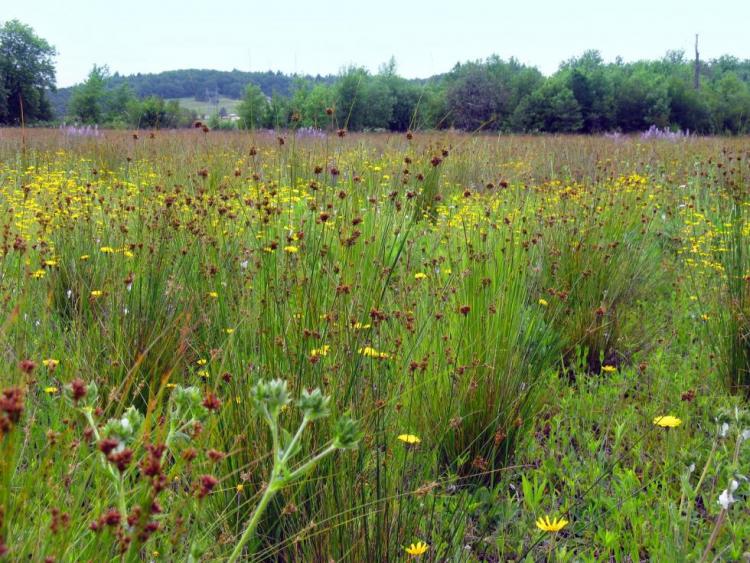
Grasslands include a variety of upland grass-dominated habitats, such as upland prairies, coastal bluffs, and montane grasslands.
Ecoregional Characteristics
Blue Mountains
Bunchgrass grasslands occur primarily in the northeastern portion of the ecoregion, although other grassy habitats occur throughout the ecoregion. At low elevations, semi-desert grasslands are dominated by drought-resistant perennial bunchgrasses, such as needle-and-thread, dropseed, threeawn, and muhly, and may have scattered shrubs. Mid-elevation plateau grasslands include extensive bunchgrass prairies of Idaho fescue, junegrass, and bluebunch wheatgrass. At high elevations, ridgetop balds and alpine parks are dominated by green or mountain fescue, needlegrass, and/or bluegrass species. High-elevation grasslands often are on south-facing slopes surrounded by subalpine conifer woodlands. There are several important grassland sites currently being managed for wildlife and habitat conservation. The Zumwalt Prairie Preserve in northeast Oregon protects native bunchgrass prairie, with a portion of the reserve designated as a National Natural Landmark.
Coast Range
Coastal bluff and montane grasslands are dominated by low-growing vegetation, such as perennial bunchgrasses, forbs, mosses, and dwarf shrubs. They occur within a matrix of conifer forests. In forested ecoregions, such as the Coast Range and West Cascades, grasslands are particularly important for rare plants and invertebrates. Outer coastal bluffs and headlands are influenced by wind and salt spray, which limit the growth of woody vegetation. Montane grasslands include dry meadows and balds and occur on dry, south- or west-facing slopes with shallow sandy or gravelly soils. They are primarily influenced by periodic fire, soil upheaval by rodents, and drought conditions.
Columbia Plateau
Grasslands include river terrace grasslands, prairies, canyon slopes, and rocky ridges. At low and mid elevations, semi-desert grasslands are dominated by drought-resistant perennial bunchgrasses, such as needle-and-thread, dropseed, threeawn, and muhly, and may have scattered shrubs. Palouse grasslands once dominated most uplands above 1,000 feet in elevation. Palouse grasslands now occur in flat areas with deep soils and are dominated by bluebunch wheatgrass, Idaho fescue, and other grasses and forbs. Canyon and foothill grasslands are found on the steeper, rocky slopes surrounding the major rivers in this region and are dominated by bluebunch wheatgrass, Idaho fescue, Sandberg’s bluegrass, balsamroot, and other forbs.
Klamath Mountains
Grasslands in the Klamath Mountains are very diverse. They can be found on valley bottoms, and include mounded prairie often associated with vernal pools (upper Rogue Valley and Agate Desert). Dry meadow grasslands and balds occur on south and west facing mid elevation slopes of the Rogue and Umpqua basins, often in a mosaic with chapparal and oak savanna. Oak savannas are grasslands with scattered trees that are usually large with well-developed limbs and canopies. The diversity of grasslands also includes the open serpentine barrens (such as in the Illinois watershed and eastern portions of the Kalmiopsis Wilderness), and in high mountain meadows and glades of the Siskiyou mountains which are a coastal sub-range of the Klamath mountains near the Oregon/California border. The Cascade Siskiyou national monument in the southern range of the Klamath Mountains ecoregion has remaining grasslands comprised of bunchgrasses.
West Cascades
Montane grasslands include open dry meadows, grasslands, and balds. Montane grassland habitats occur in a matrix of mixed conifer forests and woodlands. Mid- and high-elevation dry meadows tend to have deeper and better-drained soils than the surrounding forests and are dominated by grasses and wildflowers, such as Roemer’s fescue, alpine or western fescue, California brome, timber oatgrass, broadleaf lupine, and beargrass. Balds and bluffs generally occur on south- to west-facing slopes on shallow, well-drained soils and are dominated by bunchgrasses, forbs, and mosses.
Willamette Valley
Grasslands, also called upland prairies, are dominated by grasses, forbs, and wildflowers. Grasslands have well-drained soils and often occur on dry slopes. Willamette Valley grasslands were historically maintained by cultural burning practices. Some of the primary species include Roemer’s fescue, tufted hairgrass and culturally significant species like camas, brodiaea, and madia. They are similar to wet prairies in structure and share some of the same prairie-associated plants and animals (wet prairies are included within the Wetlands Key Habitat). Oak savannas are grasslands with scattered Oregon white oak trees, generally only one to five trees per acre (denser oak stands are included in the Oak Habitats). Oak trees in savannas are usually large with well-developed limbs and canopies.
Limiting Factors and Recommended Approaches
Limiting Factor: Altered Fire Regimes
At sites with deep soils, maintenance of grasslands is dependent, in part, on periodic fire. Fire suppression has led to encroachment by shrubs and conifer trees in some areas and has aided in an increase in fuel loads, which can lead to high-intensity wildfires. The introduction and rapid spread of cheatgrass and other non-native grasses throughout eastern Oregon can increase the frequency, intensity, and spread of fires. In the Willamette Valley in particular, grasslands and the species that inhabit them, are dependent on managed fire due to coevolution with cultural burning practices. In the Coast Range, prescribed fire is difficult due to high precipitation and wet conditions. When conditions are dry enough to use prescribed fire, there may be concerns about risk to surrounding forests. In the Klamath Mountains and Willamette Valley, prescribed fire poses challenges, such as conflicts with surrounding land use, smoke management, air quality, and safety.
Recommended Approach
Maintain open grassland structure by using multiple site-appropriate tools, such as prescribed burns, mowing, controlled grazing, hand-removal of encroaching shrubs and trees, or thinning. Re-introduce fire at locations and at times where conflicts, such as smoke and safety concerns, can be minimized. Work with partners to update smoke management and air quality standards to allow more fall, winter, and spring burn windows. For all tools, minimize ground disturbance and impacts to native species. Minimize the spread of cheatgrass. Carefully manage livestock grazing to maintain native plants and biological soil crust. Control fires in cheatgrass-dominated areas. (KCI: Disruption of Disturbance Regimes)
Limiting Factor: Invasive Species
Invasive plants have degraded grassland habitats, displacing native plants and animals. Some intentionally planted non-native species, such as crested wheatgrass, are highly competitive with native bunchgrasses and, once established, limit the growth and establishment of native plants. Depending on the area, invasive species include cheatgrass, medusahead, ventenata, rush skeleton weed, spikeweed, Hungarian brome, yellow star-thistle, knapweeds (diffuse, spotted, and purple), leafy spurge, Canada thistle, St. John’s wort, tansy ragwort, Armenian (Himalayan) blackberry, evergreen blackberry, Scotch broom, false-brome, Harding grass, and tall oatgrass. Many low-elevation grasslands are almost entirely dominated by invasive grasses, forbs, and shrubs. In the Blue Mountains and the Columbia Plateau, juniper encroachment has displaced grasslands in many areas. Disturbed sites are especially prone to invasive species establishment.
Recommended Approach
Identify remaining native grasslands and work with landowners to maintain quality and limit the spread of invasive species. Emphasize prevention, risk assessment, early detection, and quick control to prevent new invasive species from becoming fully established. To control encroaching junipers, use mastication, cut and pile, lop and scatter, or cutting for firewood. Develop markets for small juniper trees as a special forest product to reduce restoration costs. Prioritize control efforts and use site-appropriate methods to control newly established invasive plant species for which management can be most effective. Promote the development of additional native seed resources. Re-seed with site-appropriate native grasses and forbs after control efforts. Conduct research to determine methods to manage established species, such as cheatgrass, medusahead, Hungarian brome, and annual ryegrass. Where appropriate, manage livestock grazing and recreational use, especially motorized use, to minimize new introductions. Support current prevention programs, such as weed-free hay certification (KCI: Invasive Species). Clean vehicles and other equipment when relocating between sites where invasive species are present. Establish and implement management plans for all soil-disturbing activities.
Limiting Factor: Land Use Conversion
Remnant grasslands are subject to conversion to agricultural, residential, urban, energy, and infrastructure uses. Grasslands are frequently converted into croplands or pasturelands because of their deep soils and high productivity. The expansion of cities and towns often includes converting grasslands into urban and rural residential areas and associated infrastructure. The conversion of grasslands into other land uses results in habitat loss and fragmentation, degradation of ecosystem services, such as carbon sequestration, and biodiversity loss.
Recommended Approach
Because many of these areas are privately-owned, voluntary cooperative approaches are the key to long-term conservation. Important tools include financial incentives, technical assistance, regulatory assurance agreements, and conservation easements. Use and extend existing incentive programs, such as the Conservation Reserve Program and Grassland Reserve Program, to conserve, manage, and restore grasslands and to encourage no-till and other compatible farming practices. Support and implement existing land use regulations to preserve natural habitats. Use a landscape approach in conservation plans and incentive programs to create large, contiguous blocks of grassland habitat by expanding buffers around key grassland sites. Connect grassland habitats, such as fallow fields, pastures, and natural meadows, to create contiguous grassland habitat and improve connectivity between patches.
Limiting Factor: Land Management Conflicts
Resource conflicts can arise because high quality grasslands are often high-quality grazing resources. Although grazing can be compatible with conservation goals, it needs to be managed carefully because Oregon’s bunchgrass habitats are more sensitive to grazing than the sod-forming grasses of the mid-western prairies. Overgrazing can lead to soil erosion, degradation of biological soil crusts, changes in plant species composition and structure, and establishment of invasive plants. Agricultural management practices, such as mowing, haying, burning, and herbicide/insecticide application, can be detrimental to grassland species.
Recommended Approach
Use incentive programs and other voluntary approaches to manage and restore grasslands on private lands. Manage public land grazing to maintain grasslands in good condition. Conduct research and develop incentives to determine grazing regimes that are compatible with a variety of conservation goals. Restore native grassland habitat when possible, removing woody growth and invasive weeds to create a mosaic of clumped vegetation, bare ground, and a mixture of grasses and forbs with a variety of heights. Promote use of native plants and seed sources in conservation and restoration programs. Promote operation of grassland management practices (e.g., mowing, haying, burning, and herbicide application) to outside of the primary breeding season for grassland-associated wildlife (roughly April-August).
Limiting Factor: Loss of Oak Savannas
In the Klamath Mountains and Willamette Valley ecoregions, large-diameter oak trees with lateral limb structure and cavities continue to be lost. Oak Habitats complement grassland habitat and should be maintained. Many native wildlife species utilize large-diameter oaks for nesting, feeding, and shelter. Prior to European settlement, cultural burning practices helped to maintain the open structure of widely spaced, large-crowned trees with an understory of perennial native grasses and forbs.
Recommended Approach
Maintain large oaks, remove competing conifers or densely stocked small oaks, and create snags to provide cavity habitat. Management practices like prescribed fires, controlled grazing, or mowing can maintain oak savanna conditions and help to control invasive species and encroaching woody vegetation.
HABITAT CHANGE TRENDS ANALYSIS
To investigate juniper encroachment into grassland and sagebrush habitats, the Institute of Natural Resources (INR) compared the total area and spatial overlap of vegetation classes in three baseline maps (1851-1937,1998, 2016). The analysis showed significant increases in the total area of Juniper Woodlands and corresponding losses of Grassland habitats to juniper encroachment. By 2016, the total area of Juniper Woodlands had increased by 115% when compared to historical data, largely replacing Sagebrush and Grassland habitats. An estimated 15% of Grassland habitats were lost to juniper encroachment between 1851 and 1998. This analysis also showed that significant efforts by land managers and agencies, such as the BLM and Forest Service, to remove juniper have slowed encroachment in grassland habitats in recent years.
To address concerns regarding annual grass invasion of both Grassland and Sagebrush Habitats, INR conducted an analysis using the Rangeland Analysis Platform (RAP) annual vegetation cover maps to track the total area that is dominated by annual grasses in Oregon in 1986, 2001, 2016, and 2023. The analysis documented significant increases in annual-dominated vegetation since 1986. By 2001, the total area of annual-dominated vegetation increased by 118%. Between 2001 and 2016, the total area of annual-dominated vegetation increased by an additional 69%. In all years, annual-dominated vegetation was mostly found in the grassland and sagebrush habitats of southeast Oregon and in the Columbia Basin ecoregion.