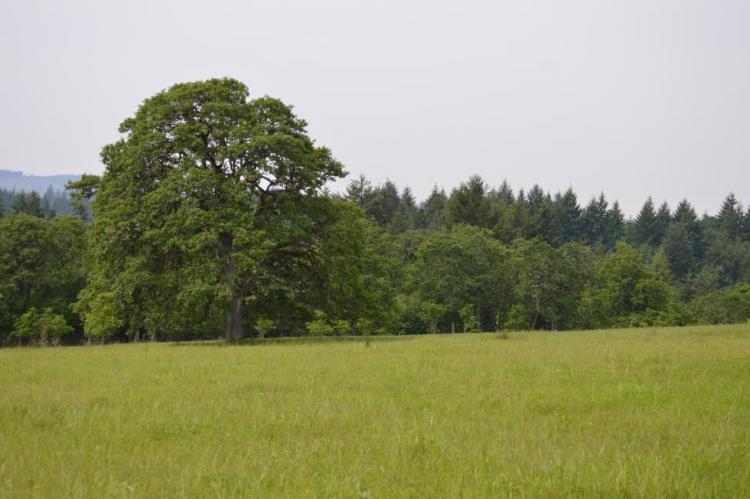
There are several oak habitat types in Oregon, where oaks comprise most of the canopy. These can include oak woodlands, oak forest, oak chaparral, and riparian oak. Oak savanna is covered in the Grasslands Key Habitat. Oaks may also co-dominate a canopy in oak/fir, oak pine, and oak hardwood habitats.
Ecoregional Characteristics
Coast Range
Oak habitats are typically found in drier landscapes, such as south-facing slopes and foothills bordering the Willamette Valley. The southwestern Oregon coast range is the northerly extent of the range of canyon live oak and tanoak.
East Cascades
In the East Cascades ecoregion, oak woodlands occur primarily on the north end of the ecoregion and in the south along the Klamath River Canyon. They are located at the transition between ponderosa pine or mixed conifer forests in the mountains, and the shrublands or grasslands to the east. Oak habitats in the East Cascades are different in structure and composition than those in western Oregon but are just as important to a variety of wildlife and rare plants.
Klamath Mountains
Oak habitats are found in lower elevations in the valley floors up to 4000’, on dry sites, or in areas with frequent, low-intensity fires. Oak woodlands may occur in a mosaic with chaparral and dry conifer woodlands. Nearing the northern extent of its range in this ecoregion, chapparal is dominated by shrubs species including buckbrush and manzanita thickets, with deer brush, yerba santa, and silk tassel making up the rest of the shrub component.
West Cascades
Oak woodland habitats are found in drier landscapes, such as south-facing slopes and foothills bordering the Willamette Valley. Oak habitats extend up to 3500’ in southwestern Oregon in the West Cascades. Portions of the West Cascades may have historically had a more closed canopy oak habitat as well as very expansive chaparral that filled the understory.
Willamette Valley
In the Willamette Valley, Oregon white oaks were originally found in a mosaic of oak savanna, forests, and riparian habitats throughout the valley floor and low-elevation slopes. One variation of oak habitat, that has almost disappeared due to historic harvest, is white oak and Willamette Valley ponderosa pine. This habitat type is found in valley bottoms and is tolerant of seasonal flooding. Oaks were most common on flat to moderately rolling terrain, usually in drier landscapes, and often between prairie remnants and conifer forests. Today, oak woodlands generally are found in small pockets and some corridors surrounded by other land uses, such as development or agriculture.
Limiting Factors and Recommended Approaches
Limiting Factor: Fire Suppression and Fir Encroachment
With fire suppression, Douglas-fir encroaches into oak habitats and eventually shades out oak trees and seedlings, as well as other plants that require open growing conditions. Many oak woodlands are now dominated by Douglas-fir or have transitioned to fir-oak habitats due to fire suppression. Without active management, these areas will eventually become conifer forests. In some areas of the East Cascades ecoregion, fire suppression combined with grazing has influenced fine fuel production and led to encroachment by conifers and establishment of dense patches of small, shrubby oaks.
Large wildfires have increased public interest in fuels reduction treatments across public and private lands. When conducted in a manner to retain some understory habitat for wildlife, such as thinning of small diameter conifers and small diameter oak-on-oak encroachment with piles and habitat clumps, oak habitats can be restored to fire resiliency and prepped for low-intensity controlled burns.
Recommended Approach
Work with partners to update smoke management and air quality standards to allow more fall, winter, and spring burn windows for prescribed burning. Use multiple tools, including prescribed fire, mowing, grazing, and selective harvest to maintain open canopy oak-dominated habitats. Increase equitable access to prescribed fire by using the Certified Burn Manager program and cultural waivers. Ensure that tools are site-appropriate and implemented to minimize impacts to native species. Re-establish site-appropriate native grasses, herbaceous plants, and shrubs.
Limiting Factor: Land Use Conversion and Continued Habitat Loss
Particularly in the Willamette Valley and Klamath Mountains ecoregions, oak habitats continue to be converted to agricultural (e.g., vineyards), rural residential, urban, and other land use changes. Remaining oaks can be impacted by soil compaction in agricultural and residential settings. The conversion of oak habitats into other land uses results in habitat loss and fragmentation for wildlife, invasive species, and the spread of diseases.
Recommended Approach
Much of the remaining oak habitat requires active management and occurs on private land, where cooperative incentive programs are the best approach. Work with private landowners to maintain and restore oak habitats and implement outreach and education efforts. Promote oak conservation on working lands through incentive programs and other collaborative efforts, such as the Wildlife Conservation and Management Program. Create new opportunities for acquisition and conservation easements to protect oak habitat, such as through the Oregon Agricultural Heritage Program. Work with local governments to protect and conserve oak habitat in local land use planning, through Statewide Planning Goal 5 as significant wildlife habitat for SGCN.
Limiting Factor: Loss of Habitat Structure
Large-diameter oak trees with lateral limb structure and cavities have been lost. In many areas, there are insufficient numbers of replacement trees to maintain these habitat elements over time. In the absence of fire, densely stocked, regenerating oaks often do not develop open-grown structures due to shading. In the East Cascades ecoregion, grazing or very hot fires can lead to development of brushy-structured trees. The shaded or grazed oaks do not develop the lateral limbs, cavities, and higher acorn crops of open-grown trees, and are thus less valuable to wildlife. Woodcutting often removes snags, which are necessary for cavity nesting species.
Recommended Approach
Maintain a diversity of tree sizes and ages across the stand, with emphasis on large oak and other key tree species appropriate to the habitat type. Remove conifers that are competing with larger oaks. Maintain existing snags and create new snags from competing conifers to provide cavity habitat. Encourage oak reproduction through plantings or protective exclosures. Improve methods to promote oak reproduction and creation of open-grown structures. Use nest boxes as temporary cavity habitat in oak restoration project areas.
Limiting Factor: Invasive Species and Diseases
In many remaining oak habitats, the overstory is intact but the understory is highly degraded. Depending on the ecoregion and site, invasive plants, such as Armenian (Himalayan) blackberry, bird cherry, evergreen blackberry, Scotch broom, English hawthorn, false brome, yellowstar thistle, diffuse knapweed, and puncturevine, have established and degraded oak habitats.
Invasive insects, such as the Mediterranean oak borer and carpenter worm moth spread diseases, cause defoliation, and weaken the structure of the trees. Fungal diseases such Sudden Oak Death and Armillaria root rot can also significantly impact oak trees.
Recommended Approach
Emphasize prevention, risk assessment, early detection, and quick control to prevent new invasive species from becoming fully established. Prioritize control efforts and use site-appropriate methods to control newly established invasive plant species for which management can be most effective. In high-risk areas, use weed-wash stations for machinery during mechanical restoration or treatment of a site. Re-seed with site-appropriate native grasses and forbs after control efforts. Prescribed burning may be useful for management of some invasive species, particularly shrubs. Support efforts toward expanding native seed resources.
Limiting Factor: Climate Change
The mean annual air temperature in the Pacific Northwest is projected to increase under a changing climate, especially during the summer months. Annual precipitation patterns in the Pacific Northwest are also predicted to change, with decreases in summer precipitation and winter snowpack. Some oak species may be tolerant of warmer and drier summer conditions, but climate change may still threaten oak habitats by amplifying existing stressors such as woody encroachment, wildfire, and disease.
Recommended Approach
Protect and restore a diverse portfolio of oak habitats and engage in strategic, landscape-scale planning efforts to create a connected network of oak habitats to preserve genetic diversity and increase adaptive capacity. Continue efforts to restore currently degraded areas and re-establish former oak habitats to increase climate resiliency. Identify where future climate conditions may support oak habitats, including areas upslope of their current range where they were not historically found. Identify data gaps and support research needs, including the protection of oak habitat on natural and working lands, to mitigate the impacts from climate change.
HABITAT TRENDS ANALYSIS
Open Oregon white oak and black oak woodlands were common across western Oregon prior to Euro-American settlement. Subsequent fire suppression and development pressures of the 20th century led to a loss of oak habitats. To investigate the magnitude of loss of oak habitats, the Institute of Natural Resources (INR) compared the total area of oak habitats in three baseline maps (1851-1937,1998, 2016). The analysis showed significant loss of oak habitats over time. By 2016, the total area of oak habitats had decreased by 72% when compared to historical data. Oak habitats were largely replaced by mixed hardwood and conifer forests and agricultural land uses.