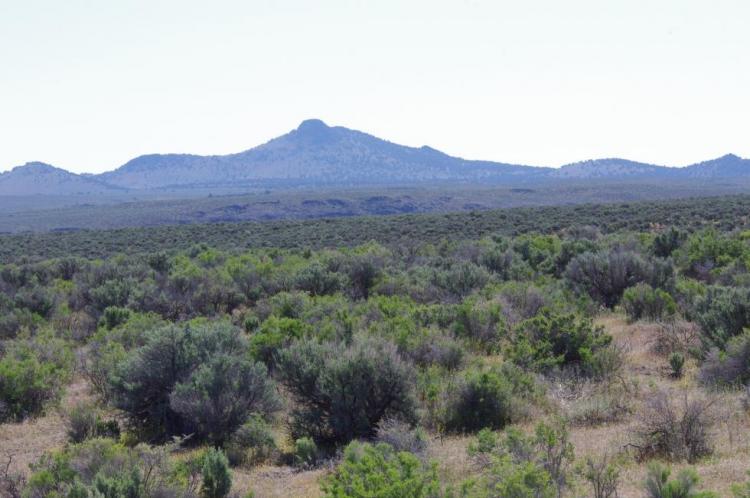
Sagebrush habitats include all sagebrush steppe- and shrubland-dominated communities found east of the Cascade Mountains.
Ecoregional Characteristics
Blue Mountains
The Blue Mountains ecoregion has both mountain big and Wyoming big sagebrush habitats. These habitats have different plant associations depending on elevation and soils, including several different subspecies of sagebrush such as low sagebrush, silver sagebrush, rigid sagebrush, basin big sagebrush, and threetip sagebrush. Other common plant species include bitterbrush, mountain mahogany, and rabbitbrush. Soils vary in depth and texture but are non-saline.
Columbia Plateau
Columbia Plateau shrub-steppe habitats are open grass-dominated communities and are usually found on loamy, wind-deposited (loess) soils. In this ecoregion, shrub-steppe communities can be broadly divided into two elevational types. Within 10 miles of the Columbia River, sandy shrub-steppe communities occur on unstable, well-drained soils with a component of bare ground or open sand present. These communities range from sagebrush steppe dominated by bitterbrush and needle-and-thread grass or Indian rice grass, to sand dune communities characterized by sagebrush, bitterbrush, and western juniper. Further from the Columbia River, both mountain big and Wyoming big sagebrush communities include basin big sagebrush, needle-and-thread grass, basin wildrye and bluebunch wheatgrass steppe, and Wyoming big sagebrush and bluebunch wheatgrass (which formerly occupied the low-elevation, loess uplands in the Columbia Plateau).
East Cascades
Sagebrush habitats occur in the East Cascades transition zone between the Cascade Mountain forests and the drier sagebrush steppe habitats of the Columbia Plateau and Northern Basin and Range ecoregions. The number of species and acreage dominated by sagebrush is lower in the East Cascades ecoregion than most other east side ecoregions, especially the Northern Basin and Range. Mountain big sagebrush and Wyoming big sagebrush habitats are both found in the East Cascades Ecoregion depending on elevation and soil type with Wyoming big sagebrush habitats found mainly along the eastern edge.
Northern Basin and Range
Big sagebrush habitats include mountain, basin, and Wyoming big sagebrush shrublands and shrub-steppe. Structurally, these habitats are composed of medium-tall to tall (1.5-6 feet) shrubs that are widely spaced with an understory of perennial bunchgrasses. Basin big sagebrush communities occur on deep silty or sandy soils along stream channels, in valley bottoms and flats, or on deeper soil inclusions in low sagebrush or Wyoming big sagebrush stands. Wyoming big sagebrush communities occur on shallower, drier soils. Mountain big sagebrush communities occur at montane and subalpine elevations on deep-soiled to stony flats, ridges, nearly flat ridge tops, and mountain slopes. The fire frequency in big sagebrush habitats ranges from 10-25 years for mountain big sagebrush and 50-100 years for Wyoming big sagebrush.
Although big sagebrush communities tend to be the dominant habitat type, other sagebrush types also provide important habitat for wildlife and may need to be considered at the local and watershed scale, or for the conservation of particular species like the Greater Sage-Grouse. For example, low sagebrush provides critical wildlife habitat for many sagebrush-obligate species. Low sagebrush habitats cover large areas of the Northern Basin and Range ecoregion, but low sagebrush communities are slow (150-300 years) to recover from significant soil disturbance or fire. Soil disturbance in these sites often results in the establishment of invasive annual grasses.
Limiting Factors and Recommended Approaches
Limiting Factor: Altered Fire Regimes
Fire suppression has resulted in undesirable changes in vegetation and contributes to increases in the intensity of wildfires. In some fire-suppressed areas, western junipers have encroached into sagebrush habitats. Dense juniper stands are not suitable for species that require open sagebrush habitats. Replacement of native bunchgrasses by cheatgrass and other invasive annual grasses has increased fire frequency and intensity in sagebrush habitats. Prescribed fire, which can be a useful tool when tailored to local conditions, is not necessarily suitable for all sagebrush habitat types. Some sagebrush habitats, including low and Wyoming big sagebrush, are extremely slow to recover from disturbance such as prescribed fire. Fire, both prescribed and natural, can increase dominance by invasive plants.
Recommended Approach
Carefully evaluate sites to determine if prescribed fire is appropriate, taking into consideration the extent of invasive annual grasses and other fire prone invasive species in the area and the recovery potential of the sagebrush community. If determined to be ecologically beneficial, reintroduce natural fire regimes using site-appropriate prescriptions. Use prescribed fire to create a mosaic of successional stages and avoid large burn patches. To control encroaching junipers, use treatment methods such as mastication, cut and pile, lop and scatter, or cutting for firewood. To ensure the long-term success of juniper removal, it may be necessary to re-treat stands on a regular basis. Develop markets for small juniper trees as a special forest product to reduce restoration costs. Maintain juniper trees with old-age characteristics, which are important for nesting birds, mule deer winter range, and other wildlife.
Limiting Factor: Invasive Species
Invasive plants, such as cheatgrass, medusahead, yellow-star thistle, knapweeds (diffuse, spotted, and purple), rush skeleton weed, spikeweed, leafy spurge, and perennial pepperweed, invade and degrade sagebrush habitats. The introduction and spread of annual grasses, such as cheatgrass and medusahead, has increased the frequency, intensity, and extent of fires in these habitats. Sagebrush and native bunchgrasses are adapted to infrequent, patchy fires, and are eliminated by hot fires. Invasive grasses also provide little nutritious value for wildlife and decrease available forage on the landscape. While not nearly as extensive as invasive plants, non-native animals have also impacted native fish and wildlife populations. Unregulated horse and burro herds are a concern in many areas, competing with native wildlife for vegetation and access to limited water sources, spreading invasive plant seeds via their manure, and trampling sensitive habitats.
Recommended Approach
Emphasize prevention, risk assessment, early detection, and quick control to prevent new invasive species from becoming fully established. Prioritize control efforts and use site-appropriate methods to control newly established species for which management can be most effective (e.g., leafy spurge and perennial pepperweed). Cooperate with partners through habitat programs and County Weed Boards to address invasive species problems. Oregon’s SageCon Invasives Initiative can be used for state-wide planning and coordinating implementation and funding toward shared priority areas. Reintroduce shrubs, grasses, and forbs at control sites through seeding and/or planting. In some cases, it may be desirable to use “assisted succession” strategies, using low seed rates of non-invasive, non-native plants in conjunction with native plant seeds as an intermediate step in rehabilitating disturbances to sagebrush habitat. Prevent and control wildfires in areas where cheatgrass dominates in the understory. Conduct research to determine methods to manage established species such as cheatgrass and medusahead. Minimize soil disturbance in high priority areas to prevent the establishment of invasive species. Work with public land managers to develop effective and enforceable travel management rules to prevent the spread of noxious weeds. Promote dialogue between wildlife managers, landowners, and land managers to develop horse management plans based on common priorities. Provide outreach to explain the issue to the public and the impacts of unregulated herds on wildlife and habitat.
Limiting Factor: Damage to Biological Soil Crusts
The soil surface of many sagebrush habitats is made up of a community of lichens, bryophytes, algae, bacteria, and fungi that make up the biological soil crust. These soil crusts contribute to biodiversity and nutrient cycling and improve soil stability and structure but are sensitive to disturbance. Unmanaged grazing, agricultural practices, development, and unregulated OHV use can damage soil crusts, which leads to soil erosion, changes in plant species composition and structure, and degradation by invasive plants.
Recommended Approach
Voluntary cooperative approaches are the key to long-term conservation of sagebrush on private lands. Use tools such as financial incentives, technical assistance, regulatory assurance agreements, and conservation easements to achieve conservation goals. Work with public land managers to ensure grazing is carefully managed and that soil crusts are considered in management plans. Create effective travel management laws for off-highway vehicle use that can be successful and enforced.
Limiting Factor: Conversion to Other Land Uses
Remnant shrub-steppe habitats are subject toland use conversion, such as to agriculture, urban and rural development, and energy projects. For example, in the Columbia Plateau and Northern Basin and Range ecoregions, thousands of acres are being converted to largescale solar energy projects. Large solar array installations can impact wildlife habitats and block migratory corridors with the development footprint or through exclusion by project fencing. Mining exploration and development also contribute to sagebrush habitat loss with both a direct loss as a result of the mine development and extraction processes, and indirect impacts such as runoff as a result of the mining operations. Recreation can have negative impacts from off-highway vehicles or dispersed camping in sensitive habitat or during wet seasons. In the Blue Mountains and East Cascades ecoregions, rapidly growing human populations, especially near Bend, Redmond, and Madras, are resulting in land use conversion, habitat loss, and habitat fragmentation.
Recommended Approach
Use tools such as financial incentives and conservation easements to conserve priority sagebrush habitats on private lands. For example, re-establishing the shrub component of lands enrolled in the Conservation Reserve Program has helped to restore habitat structure. Work with community leaders and local governments to ensure that development is planned and consistent with local conservation priorities. Support and implement existing land use regulations to preserve farm and range land, open spaces, recreation areas, and natural habitats from incompatible development.
Limiting Factor: Loss of Habitat Connectivity
In the Columbia Plateau, remnant shrub-steppe habitats often occur in small patches, such as roadsides and field edges. These patches are valuable habitat for some species, especially SGCN plants and invertebrates. However, small size and poor connectivity of remnant patches limits dispersal for sagebrush-associated species.
Recommended Approach
Maintain high priority patches and improve connectivity. Habitat connectivity may be restored by working to promote native ecological communities and by restoring degraded habitat. Protect habitat through land acquisition, execution of conservation easements, specific designations within policy, or long-term management to promote wildlife use. Consider connectivity in advance of any land use, development, resource extraction, energy, or transportation project or planning process. Avoid habitat development or disturbance within critical movement areas, such as Priority Wildlife Connectivity Areas, riparian corridors, and migratory pathways. (KCI: Barriers to Animal Movement)
HABITAT CHANGE TRENDS ANALYSIS
Transition to Juniper Woodlands
Western juniper is distributed across most of eastern Oregon and historically formed open woodlands with sparse understories. After European settlement, however, western juniper began establishing and spreading into new areas, often forming dense stands with substantial understories, while open, old growth woodlands declined. With this expansion, juniper has invaded many of the grasslands and shrublands in eastern Oregon, altering the structure and function of many sagebrush habitats.
To investigate juniper encroachment into grassland and sagebrush habitats, the Institute of Natural Resources (INR) compared the total area and spatial overlap of vegetation classes in three baseline maps (1851-1937,1998, 2016). The analysis showed significant increases in the total area of Juniper Woodlands and corresponding losses of Big Sagebrush habitats to juniper encroachment.
By 2016, the total area of Juniper Woodlands had increased by 115% when compared to historical data, largely replacing Sagebrush and Grassland habitats. An estimated 38% of Big Sagebrush habitats were lost to juniper encroachment between 1851 and 1998. Between 1998 and 2016, an estimated 25% of Big Sagebrush habitats were replaced by Juniper Woodlands. This analysis shows that significant efforts by land managers and agencies, such as the BLM and U.S. Forest Service, to remove juniper have slowed encroachment in sagebrush habitats in recent years.