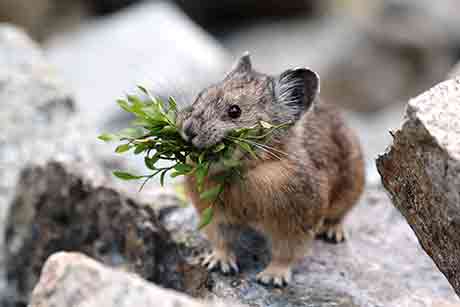
The American pika is a small lagomorph typically confined to rocky habitats usually in higher elevation areas. The American pika has a discontinuous patchy distribution in mountainous areas of Oregon and western North America, primarily within the Great Basin, Cascade Range, and Rocky Mountain Range. American pikas are overall stout and rounded, with short legs and a tail that is not visually apparent. Ears are large, round, haired on both surfaces, and dark in color with white margins. Pelage varies in color by season, ranging from gray to cinnamon brown dorsally during the summer, becoming longer and grayer in the winter. Underfur is dense, usually gray in color. Ventral fur is whitish. Adult length ranges from 162 to 216 mm nose to tail, with variation in length between populations. Adult weight ranges between 121 to 176 g. Compared to other lagomorphs, they have relatively short hind feet relative to their body; feet are 25 to 35 mm in length. The soles of the feet are densely furred.
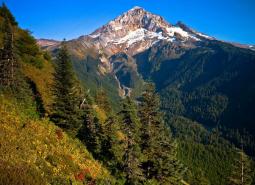
American pikas require talus, creviced rock, and other microhabitats that provide cool microclimates. They need adequate forage close to rocky crevices. Pikas are typically found at high-elevation sites often associated with alpine habitat, likely due to the species’ need for cool, moist climates and sensitivity to temperatures above 25.5 °C. Oregon does have unique low-elevation (just above sea level) populations on talus slopes along the Columbia River Gorge (WC), and Fox Valley, Linn County, which meet the species’ thermal and other needs outside of alpine habitat. American pikas occupy the same habitats year-round.
Limiting factors
American pikas are very sensitive to high temperatures and require cool microclimates in talus slopes and underground. They have limited dispersal ability, low fecundity, and are vulnerable to recreation pressure (development of alpine infrastructure may degrade habitat), road development, livestock grazing, and changes in climatic factors including decreases in snowpack and shifting patterns of precipitation. Road construction, especially in high-traffic areas in lower elevations, may cause significant fragmentation of pika habitat. Isolated, small populations might be at risk of local extirpation. The most significant threat to American pika persistence is changing climate conditions.
Data gaps
• Assess distribution, abundance, and trends.
• Determine estimates of fecundity and reproductive success in isolated populations.
• Improve understanding of potential climate change impacts on predation, competition, and foraging dynamics.
• Determine home-ranges and potential areas from improved connectivity to minimize isolated ‘island clusters’ on the landscape.
• Assess the significance of low genetic diversity on the effectiveness of conservation actions – especially for O. p. fenisex.
Conservation actions
• Improve monitoring efforts to verify population trends.
• Identify isolated populations that may be vulnerable to climate change and connectivity issues.
• Determine and implement effective mitigation and habitat conservation techniques to provide habitat connectivity.
Smith, A., Conservation status of American pikas (Ochotona princeps) 2020. Journal of Mammalogy, 101(6):1466–1488, 2020.
Smith, A.B., Beever, E.A., Kessler, A.E. et al. Alternatives to genetic affinity as a context for within-species response to climate. Nat. Clim. Chang. 9, 787–794 (2019). Read here