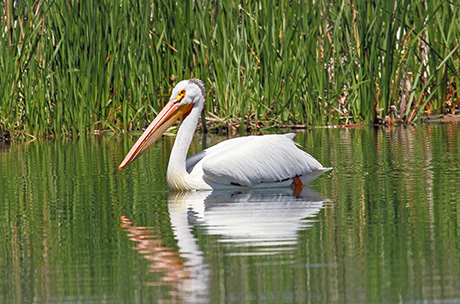
The American White Pelican (Pelecanus erythrorhynchos) is a large white bird with black primaries and outer secondaries. It has an enormous bill with distensible ‘gular’ pouch, and webbed feet. It usually occurs in flocks, and flies with its characteristic head withdrawn. In early breeding season, its bill and legs are bright orange, its head with white plumes and laterally flattened “horn” on upper mandible. The species typically nests colonially on islands associated with fresh or brackish water habitats, including lakes, impoundments, embayments, marshes, and estuarine areas. Most birds that breed in Oregon are resident year round.
Overview
- Species Common Name American White Pelican
- Species Scientific Name Pelecanus erythrorhynchos
- State Listing Status Sensitive
Ecoregions

East Cascades
The East Cascade ecoregion extends from the Cascade Mountains' summit east to the warmer, drier high desert and down the length of the state. This ecoregion varies dramatically from its cool, moist border with the West Cascades ecoregion to its dry eastern border, where it meets sagebrush desert landscapes.

Northern Basin and Range
The Northern Basin and Range ecoregion covers the very large southeastern portion of the state, from Burns south to the Nevada border and from the Christmas Valley east to Idaho. It is largely a high elevation desert-like area dominated by sagebrush communities and habitats.